Research overview
Selank: what the research shows
What is Selank?
Selank is a synthetic seven-amino-acid peptide, Thr-Lys-Pro-Arg-Pro-Gly-Pro [1]. Its first four residues are tuftsin (Thr-Lys-Pro-Arg) [20], an endogenous immunomodulatory tetrapeptide [2], and the C-terminal Pro-Gly-Pro tripeptide is the same tail found in Semax [3].
Selank comes from the same Moscow research program as Semax, centered on the Institute of Molecular Genetics of the Russian Academy of Sciences, and most of its literature was produced there and at a few partner institutes [4] [5]. It is listed as a registered medicine in Russia [6] and is not approved in the United States. A 2021 U.S. pharmacology review described it as a poorly studied Russian drug with a GABAergic mechanism [7].
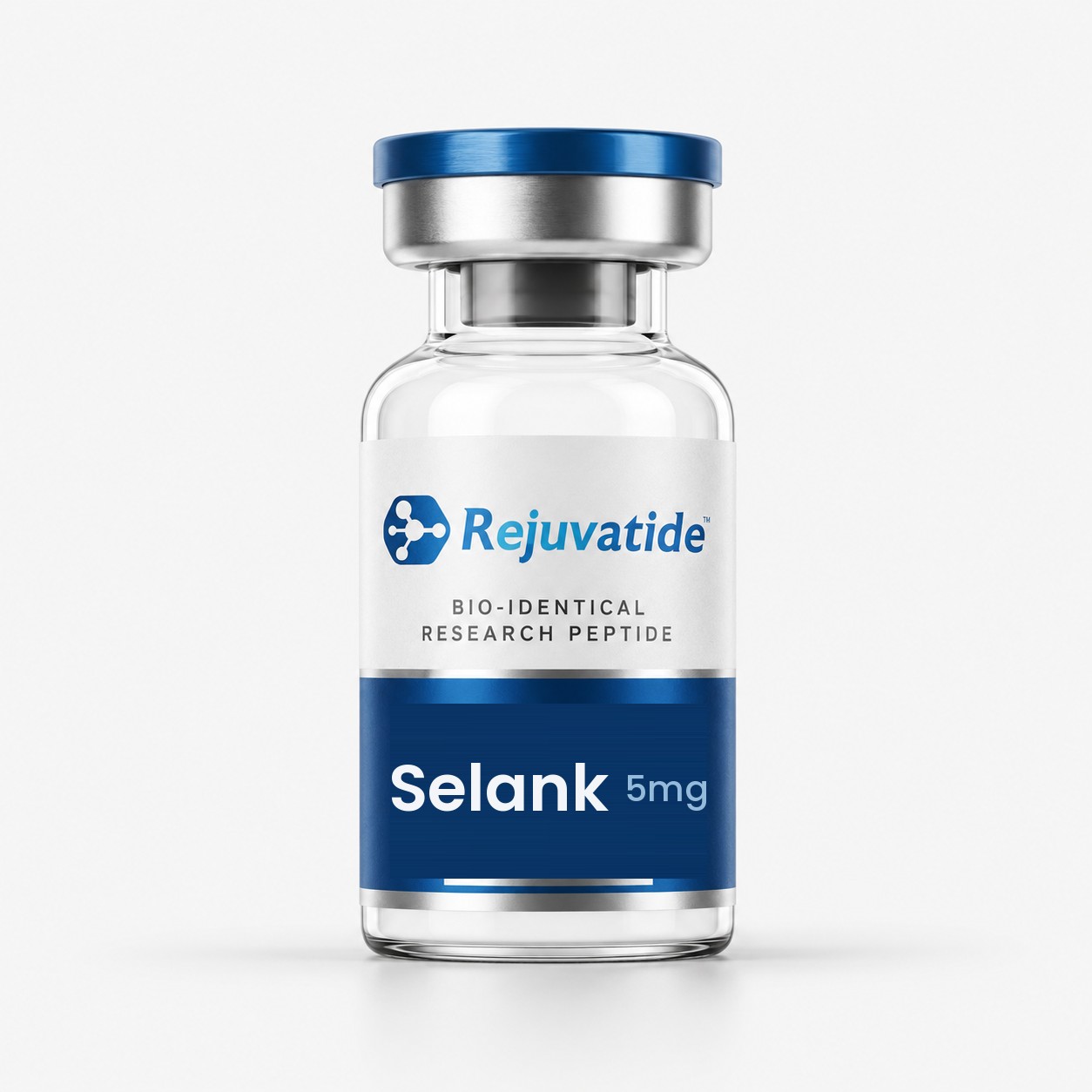
Selank is also a component of our Selank / Semax Blend.
| Sequence | Thr-Lys-Pro-Arg-Pro-Gly-Pro (TKPRPGP) |
|---|---|
| Length | 7 amino acids (heptapeptide) |
| Molecular formula | C33H57N11O9 |
| Molecular weight | 751.9 g/mol |
| CAS number | 129954-34-3 (PubChem synonym) |
| PubChem CID | 11765600 |
| Other names | TP-7, Selanc (PubChem synonyms) |
Mechanisms studied
No mechanism for Selank has been confirmed in humans. Most proposed mechanisms come from rodent tissue and cell studies by the developing institute.
GABA-A receptor modulation
In a 2018 radioligand study using rat brain membranes, Selank behaved as a positive allosteric modulator of [3H]GABA binding. When combined with certain benzodiazepines, the effect was not additive, and Selank blocked the modulatory activity of diazepam and olanzapine. The authors concluded that Selank's binding site is probably distinct from, but may partly overlap with, those of these drugs [4].
Gene expression in the GABAergic system
In rat frontal cortex, a qPCR panel of 84 neurotransmission genes showed that Selank altered the expression of 45 genes at one hour and 22 genes at three hours, with changes that correlated positively with those produced by GABA [5]. In contrast, a follow-up study in human IMR-32 neuroblastoma cells found no change in the mRNA levels of the same gene set with Selank alone, although Selank modified the gene-expression changes produced by GABA and by olanzapine [8].
Enkephalin-degrading enzymes
In human plasma, Selank inhibited enzymatic hydrolysis of enkephalin with an IC50 of about 15 micromolar, and was more potent than the peptidase inhibitors bacitracin and puromycin [9]. A parallel study reported similar inhibition by both Selank and Semax in human serum [10].
Immune and inflammation-related genes
Consistent with its tuftsin origin, Selank has been studied for effects on immune gene expression. In mouse spleen, it rapidly changed mRNA levels of C3, Casp1, Il2rg, and Xcr1, and its Gly-Pro fragment produced largely matching profiles, which the authors suggested means the dipeptide contributes to Selank's overall effect [11].
Areas of research
Rodent behavior models
In a 2017 rat study using unpredictable chronic mild stress and the elevated plus maze, Selank given alone and combined with diazepam changed anxiety-related measures, and the combination returned measures under chronic stress to pre-stress values [12]. In rats with 6-OHDA lesions of dopaminergic neurons, Selank did not change motor activity but reduced anxiety-related behavior in the elevated plus maze, while Semax had neither effect [13].
Withdrawal models
In a 2022 study of naloxone-precipitated morphine withdrawal in rats, Selank reduced the overall withdrawal index by 39.6 percent and attenuated convulsive reactions, ptosis, and posture disorders. Diazepam produced a somewhat larger effect in the same model [14].
Hippocampal BDNF and memory models
In a 2019 study in rats given ethanol as their only fluid for 30 weeks, the authors reported that Selank prevented the memory and attention deficits seen in an object recognition test during withdrawal, and prevented the ethanol-induced rise in BDNF content in the hippocampus and frontal cortex [15].
Open research questions
- Identification of a specific Selank binding site, since the GABA-A findings describe allosteric effects without a defined receptor site [4].
- Why rat cortex and human neuroblastoma cells gave different gene-expression results [5] [8].
- Independent replication, abuse liability, and human pharmacokinetics, none of which are well characterized [7] [16].
Where the evidence comes from
Nearly all Selank research comes from a small group of Moscow institutions, principally the Institute of Molecular Genetics of the Russian Academy of Sciences and a few partner institutes, and much of it is published in Russian or in translated Russian journals. Several mechanism papers share the same core authors [4] [5] [8] [11] [12].
Outside Russia, Selank appears in the literature mainly in regulatory and forensic contexts. A 2020 Belgian study identified Selank and Semax in seized preparations and noted that, to the authors' knowledge, neither had completed clinical trials [16]. A 2021 U.S. review urged that GABA-active agents be evaluated for abuse potential before public access [7].
State of the human evidence
Human studies of Selank are few, small, and published in Russian-language journals, mostly comparisons with benzodiazepine drugs in patients with anxiety-spectrum diagnoses [17]. We found no independent clinical studies from outside Russia, and FDA states that it lacks important information about safety issues raised by Selank acetate in humans [18].
Findings from animal and cell models, and from small clinical reports outside the U.S. regulatory system, should not be read as evidence of safety or benefit in people.
Regulatory status
- Not FDA approved. Selank is not approved by the U.S. Food and Drug Administration for any use. It is listed as a registered medicine in Russia [6], which has no bearing on its U.S. status.
- Compounding. FDA's list of bulk drug substances that may present significant safety risks (content current as of April 22, 2026) includes Selank acetate (TP-7) among nominated substances that were later withdrawn. FDA notes a possible risk of immunogenicity for certain routes due to aggregation and peptide-related impurities, and states that it lacks important information about safety issues raised by Selank acetate administered to humans [18].
- Advisory committee. Selank was not among the seven peptides reviewed at FDA's Pharmacy Compounding Advisory Committee meeting of July 23 and 24, 2026 [19]. Status checked 2026-10-12.
Rejuvatide supplies Selank strictly as a research chemical for in vitro and laboratory use. It is not sold for human or veterinary use.
Testing and quality
Every Rejuvatide lot of Selank is tested by an independent laboratory for purity by HPLC and identity by mass spectrometry, and is also tested for endotoxin. The current certificates are shown below and in our COA library, where you can match the lot number on your vial to its report. Certificates are published exactly as the laboratory issued them.
Browse all neuroscience research compounds, or see our FAQ for ordering and shipping questions.
Storage of lyophilized material
Selank ships as a lyophilized (freeze-dried) powder, which is stable at ambient temperature during transit. For long-term storage, keep sealed vials at -20°C, protected from light and moisture. Allow a vial to reach room temperature before opening to limit condensation. Handling of any prepared solutions should follow your laboratory's own validated procedures.