Research overview
Thymosin Alpha-1: what the research shows
What is thymosin alpha-1?
Thymosin alpha-1 (Tα1) is a 28-amino-acid peptide with an acetylated N-terminus. Its nonproprietary drug name is thymalfasin [1]. It was first isolated from calf thymus as one of several polypeptides in a preparation known as thymosin fraction 5, and its sequence was published in 1977. The authors described it as a heat-stable, highly acidic molecule [3].
Although it was discovered in thymus extracts, Tα1 is not a thymus-specific gene product. Its sequence matches the first 28 residues (after the initiating methionine) of prothymosin alpha, a larger protein encoded by the PTMA gene [2]. A 1985 study of calf thymocytes reported evidence that Tα1 arises by natural processing of this precursor [4], and a later review described Tα1 as produced in vivo by cleavage of prothymosin alpha in diverse mammalian tissues [7].
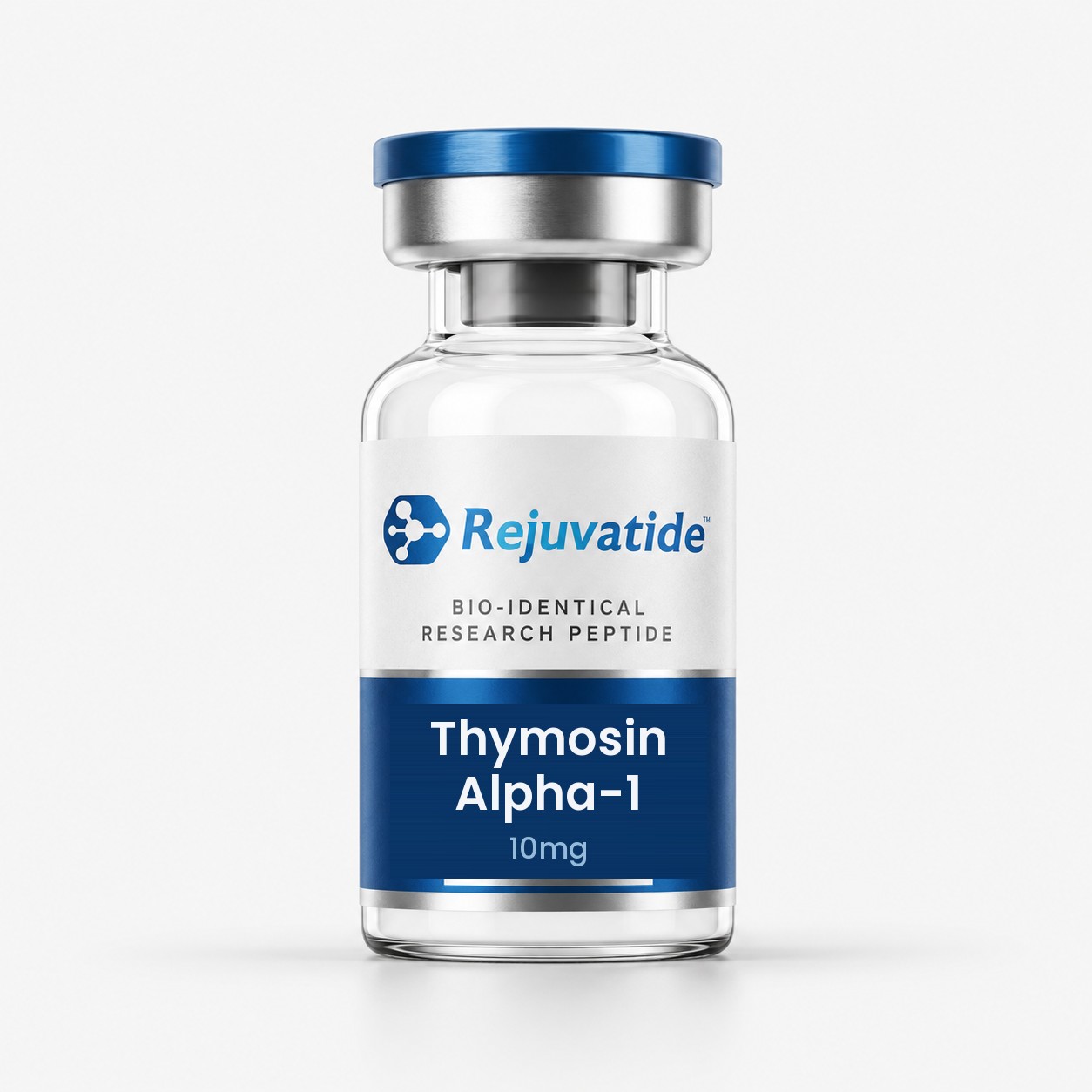
Unlike most research peptides, Tα1 has a long clinical history outside the United States, covered in the human evidence and regulatory sections below. That history should not be confused with the status of research-grade material: Rejuvatide's product is a synthetic research chemical, not a medicine.
| Sequence | Ac-Ser-Asp-Ala-Ala-Val-Asp-Thr-Ser-Ser-Glu-Ile-Thr-Thr-Lys-Asp-Leu-Lys-Glu-Lys-Lys-Glu-Val-Val-Glu-Glu-Ala-Glu-Asn (Ac-SDAAVDTSSEITTKDLKEKKEVVEEAEN) |
|---|---|
| Length | 28 amino acids, N-terminally acetylated |
| Molecular formula | C129H215N33O55 |
| Molecular weight | 3108.3 g/mol |
| CAS number | 62304-98-7 |
| PubChem CID | 16130571 |
| Other names | Thymalfasin (INN), thymosin alpha1, Tα1 (PubChem synonyms) |
Mechanisms studied
Research on how Tα1 acts has centered on dendritic cells, the immune cells that sense infection and tissue stress and shape the T-cell response. Most of the mechanistic work summarized here comes from a group at the University of Perugia.
Toll-like receptor signaling in dendritic cells
In a 2004 study, Tα1 induced functional maturation and interleukin-12 production by mouse dendritic cells exposed to the fungus Aspergillus fumigatus. The effect ran through the p38 MAP kinase and NF-kappaB pathway and depended on MyD88-linked Toll-like receptor signaling. In mice that had received hematopoietic transplants, the synthetic peptide was associated with T-helper type 1 antifungal immunity and protection from aspergillosis [5].
Tryptophan catabolism and regulatory T cells
A 2006 study by the same group found that Tα1 induced expression and activity of indoleamine 2,3-dioxygenase (IDO) in mouse dendritic cells, an enzyme that breaks down tryptophan and is linked to immune tolerance. IDO activation required TLR9 and type I interferon receptor signaling and was accompanied by interleukin-10 production and the generation of regulatory T cells [6].
Plasmacytoid dendritic cells and viral sensing
A 2007 study infected susceptible, resistant, and Toll-like-receptor-deficient mice with murine cytomegalovirus. The authors reported that Tα1 protected susceptible and resistant mice, and that the effect ran through activation of plasmacytoid dendritic cells via TLR9 and MyD88, leading to activation of interferon regulatory factor 7 and an interferon-alpha and interferon-gamma effector pathway [13].
A dual role in the reviewed model data
A 2007 review drew these findings together. It summarized work in which Tα1 primed dendritic cells for antifungal resistance, activated plasmacytoid dendritic cells through TLR9 in a mouse cytomegalovirus model, and induced IDO-dependent tolerance in transplantation and allergy models. The authors proposed that Tα1 acts as an endogenous regulator that can promote immunity and tolerance depending on context [7].
Areas of research
Infection models
Preclinical infection research on Tα1 has used fungal and viral challenge models in mice, chiefly aspergillosis and cytomegalovirus, with dendritic-cell function as the readout [5] [7].
Tumor models in combination studies
A 2007 review traced an earlier line of research in which Tα1 was combined with interferon or interleukin-2 plus chemotherapy in animal tumor models, including Lewis lung carcinoma, Friend erythroleukemia, and B16 melanoma in mice and colorectal cancer liver metastasis in rats. The review also discussed mechanisms such as increased expression of major histocompatibility complex molecules [14].
Immune tolerance and inflammation models
The IDO findings led to studies of tolerance in transplantation and allergic inflammation models, described in the 2007 review [6] [7].
Clinical-research context
A 2020 literature review summarized the clinical settings in which Tα1 has been investigated [9]. These are areas of investigation, not established uses, and are not described further here.
Open research questions
- The receptor-level basis of Tα1 activity, given that much of the evidence describes downstream Toll-like receptor pathways rather than a single defined receptor [7].
- How closely the mouse dendritic-cell findings translate to human immune cells.
- The relationship between circulating Tα1 and its precursor, prothymosin alpha, in different tissues [4].
State of the human evidence
Tα1 has more human data than most research peptides, and reviews have summarized its clinical investigation across several settings [9]. The earlier studies vary widely in size and design, and the largest recent trial did not meet its primary outcome.
The clearest recent example is the TESTS trial, a multicentre, double-blind, placebo-controlled phase 3 trial run at 22 centres in China and published in 2025. It enrolled 1,106 adults with sepsis, and its primary outcome was 28-day all-cause mortality. The investigators reported no clear evidence that Tα1 reduced 28-day mortality, and no secondary or safety outcome differed significantly between groups [10].
Findings from animal and cell models, and from clinical studies in specific patient groups, should not be read as evidence that research-grade material is safe or beneficial in people.
Regulatory status
- Not FDA approved. We found no FDA-approved drug containing thymalfasin in Drugs@FDA (checked October 12, 2026) [12].
- Approved outside the United States. Thymalfasin is approved as a prescription medicine in a number of countries outside the US. A 2007 account by the company that licensed it for regions excluding the United States and Europe reported approvals in more than 30 countries [8]. Approval elsewhere does not make a research-grade vial equivalent to that medicine.
- Compounding. FDA's page of bulk drug substances that may present significant safety risks (content current as of April 22, 2026) lists thymosin-alpha 1 among substances whose nominations were withdrawn by the nominators. Its entry states that compounded drugs containing Tα1 may pose significant risk for immunogenicity for certain routes of administration, may have complexities with peptide-related impurities and API characterization, and that the available safety information is inadequate for the agency to understand the extent of any safety issues [11].
Rejuvatide supplies thymosin alpha-1 strictly as a research chemical for in vitro and laboratory use. It is not sold for human or veterinary use.
Testing and quality
The current lot of Rejuvatide thymosin alpha-1 was tested by an independent laboratory for purity by HPLC and identity by mass spectrometry, and has a separate USP <85> endotoxin certificate for the same lot. Both certificates are shown below and in our COA library, where you can match the lot number on your vial to its report. Certificates are published exactly as the laboratory issued them.
Thymosin alpha-1 is unrelated to TB-500, which is associated with a different thymic protein, thymosin beta-4; see our TB-500 research peptide page for that compound. For another thymus-derived research material, see Thymalin, or browse all immune and cellular research peptides.
Storage of lyophilized material
Thymosin alpha-1 ships as a lyophilized (freeze-dried) powder. For long-term storage, keep sealed vials at -20°C, protected from light and moisture. Allow a vial to reach room temperature before opening to limit condensation. Handling of any prepared solutions should follow your laboratory's own validated procedures.