Research overview
Pinealon: what the research shows
What is Pinealon?
Pinealon is a synthetic tripeptide made of glutamic acid, aspartic acid, and arginine (Glu-Asp-Arg, often written EDR) [1]. It belongs to a family of very short peptides that a research group in St. Petersburg, Russia, led by Vladimir Khavinson, has studied for many years under the label "peptide bioregulators."
The group's central hypothesis is that peptides this short can enter cells and interact with DNA or histone proteins to influence gene expression [2] [3]. That idea is not established outside this research network, and the findings below should be regarded as preliminary.
| Sequence | Glu-Asp-Arg (EDR) |
|---|---|
| Length | 3 amino acids (tripeptide) |
| Molecular formula | C15H26N6O8 |
| Molecular weight | 418.4 g/mol |
| CAS number | 175175-23-2 (PubChem synonym) |
| PubChem CID | 10273502 |
| Other names | EDR peptide, L-glutamyl-L-aspartyl-L-arginine, H-Glu-Asp-Arg-OH (PubChem synonyms) |
What has been studied
Oxidative stress in cultured cells
In a 2011 study, Pinealon limited the accumulation of reactive oxygen species in rat cerebellar granule cells, neutrophils, and PC12 pheochromocytoma cells exposed to oxidative stress, and reduced necrotic cell death measured by propidium iodide staining. The protective effect came with delayed ERK1/2 activation. Because the antioxidant effect leveled off at lower concentrations while changes in cell proliferation continued at higher ones, the authors proposed that Pinealon also interacts directly with the cell genome [2].
A prenatal rat model
In a 2012 study, pregnant rats were fed a methionine-loaded diet to raise homocysteine levels. The authors reported that offspring of mothers that also received Pinealon showed better spatial orientation and learning, and their isolated cerebellar neurons accumulated less reactive oxygen species and showed fewer necrotic cells, than offspring of untreated methionine-loaded mothers [4].
Dendritic spines in amyloid models
A 2021 study reported that EDR and a related tripeptide, KED, prevented dendritic spine loss in an in vitro model of amyloid synaptotoxicity and in 5xFAD transgenic mice. The authors also used molecular docking to propose binding sites for EDR in the promoter regions of genes including CASP3, GAP43, APOE, SOD2, PPARA, and PPARG [3]. The docking results are computational predictions, not measured binding.
Induced human neurons
A 2024 study converted skin fibroblasts from elderly donors into cortical neurons in culture. EDR, KED, and the tetrapeptide AEDG increased dendrite branching and total dendrite length. EDR reduced oxidative DNA damage in these neurons, while none of the peptides changed mitochondrial or lysosomal activity or p16 protein levels [5].
How strong is the evidence?
Weak, and we think it is important to say so plainly.
- One research network. Every Pinealon study cited on this page, and nearly all of the PubMed literature we found, comes from Khavinson's group or its close collaborators in St. Petersburg [2] [3] [4] [5]. We found no independent replication.
- Small, early studies. The published work consists of cell-culture experiments, a small number of rodent studies, computational docking, and reviews by the same authors. Several related papers are in Russian-language journals.
- Unproven mechanism. The proposal that a three-residue peptide regulates specific genes by binding DNA or histones is the group's own hypothesis [6] and has not been confirmed by outside laboratories.
- No meaningful human data. A 2020 review by the group refers to findings in elderly people [6], but we found no controlled clinical trial of Pinealon in PubMed. There is no basis for any conclusion about safety or effects in people.
Pinealon may be a reasonable tool for laboratories that want to test these hypotheses independently, which is exactly what the literature currently lacks.
Regulatory status
- Not FDA approved. Pinealon is not approved by the U.S. Food and Drug Administration for any use.
- Compounding. Pinealon does not appear on FDA's page of bulk drug substances that may present significant safety risks (content current as of April 22, 2026) [7], and it was not among the peptides reviewed at FDA's Pharmacy Compounding Advisory Committee meeting of July 23 and 24, 2026 [8]. Neither of these facts implies any approval or endorsement. Status checked 2026-10-12.
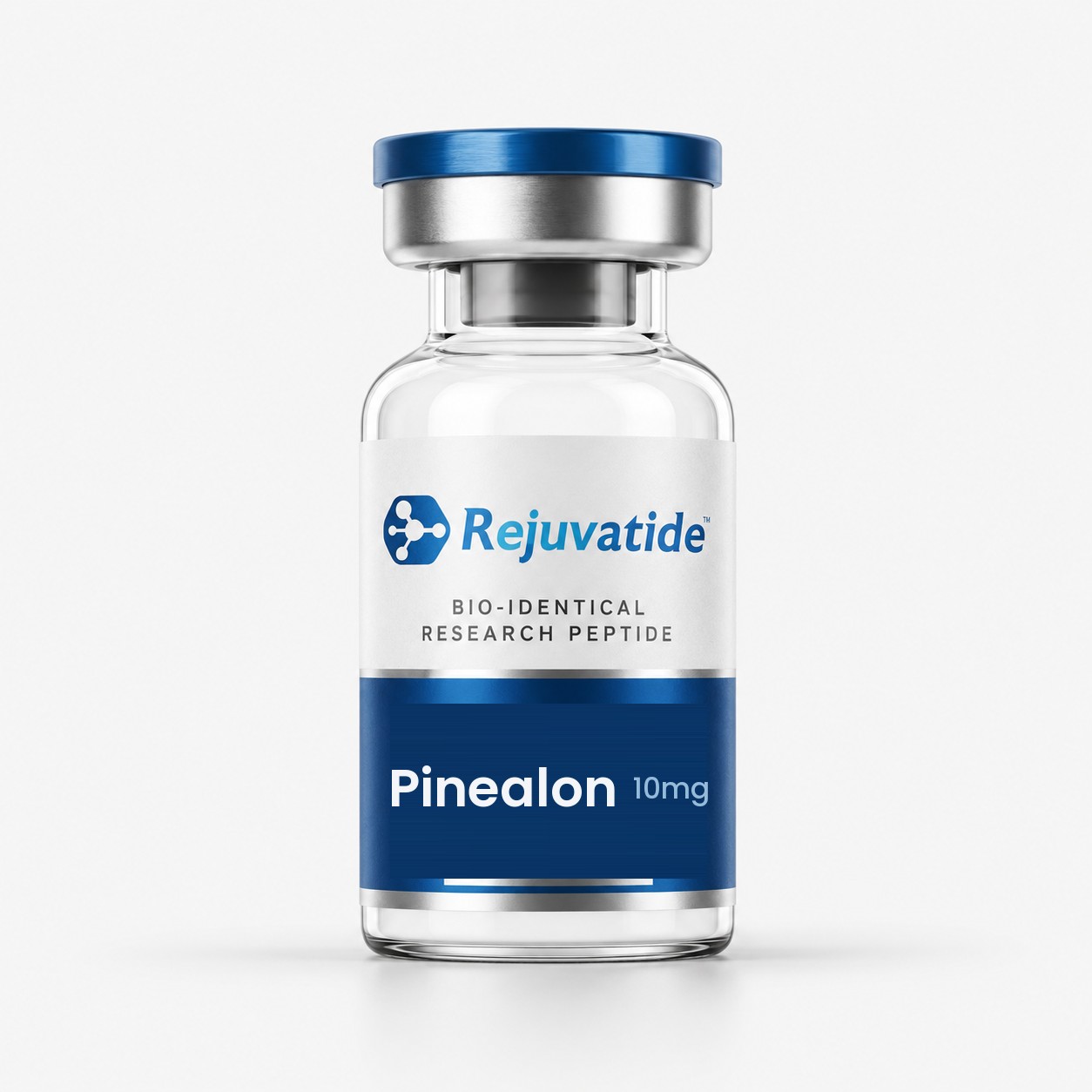
Rejuvatide supplies Pinealon strictly as a research chemical for in vitro and laboratory use. It is not sold for human or veterinary use.
Testing and quality
Every Rejuvatide lot of Pinealon is tested by an independent laboratory for purity by HPLC and identity by mass spectrometry, and is also tested for endotoxin. The current certificates are shown below and in our COA library, where you can match the lot number on your vial to its report. Certificates are published exactly as the laboratory issued them.
Browse all neuroscience research compounds, or see our FAQ for ordering and shipping questions.
Storage of lyophilized material
Pinealon ships as a lyophilized (freeze-dried) powder, which is stable at ambient temperature during transit. For long-term storage, keep sealed vials at -20°C, protected from light and moisture. Allow a vial to reach room temperature before opening to limit condensation. Handling of any prepared solutions should follow your laboratory's own validated procedures.