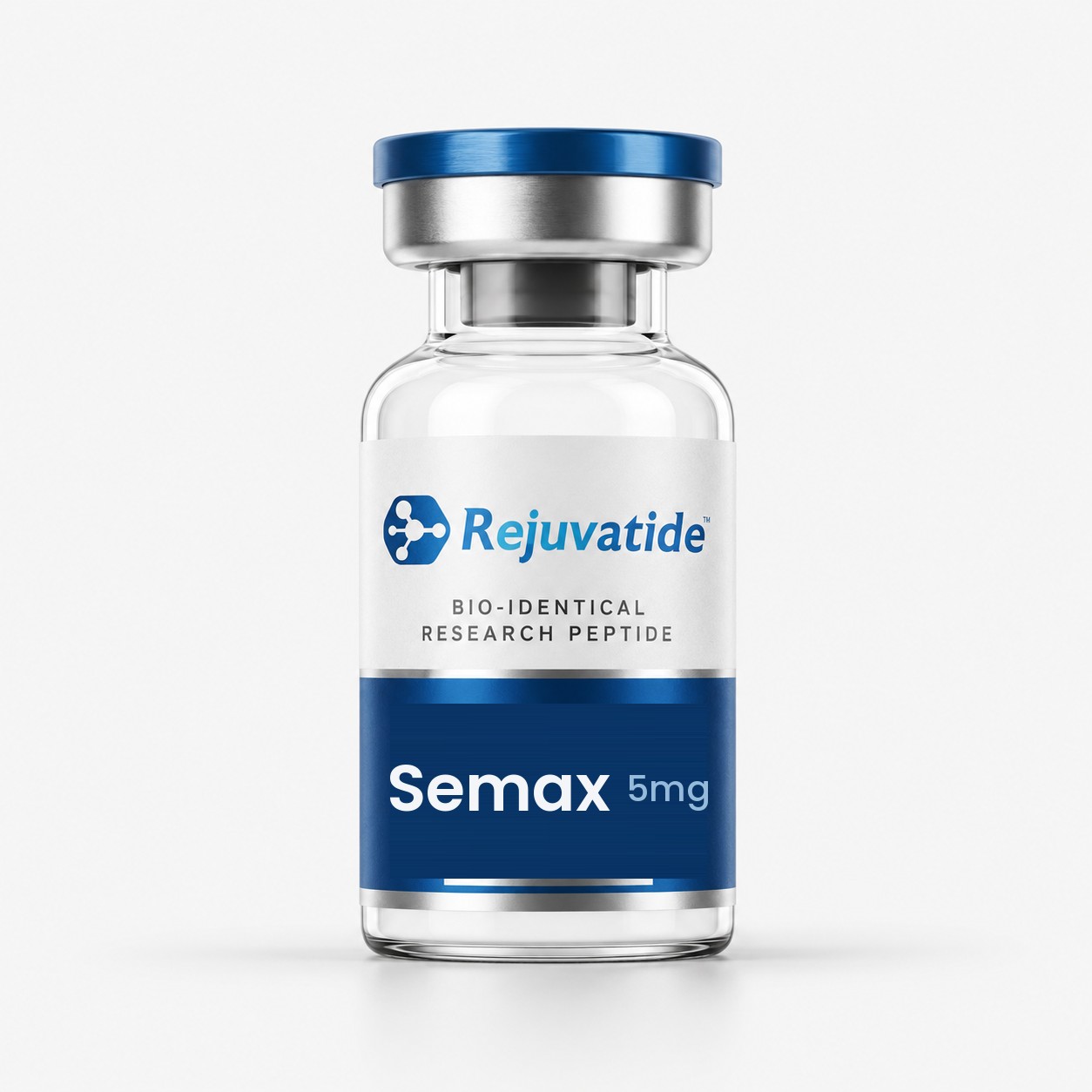
Research overview
Semax: what the research shows
What is Semax?
Semax is a synthetic seven-amino-acid peptide, Met-Glu-His-Phe-Pro-Gly-Pro [1]. Its first four residues reproduce positions 4 to 7 of adrenocorticotropic hormone (ACTH), followed by a C-terminal Pro-Gly-Pro tripeptide. Because of that origin it is usually described in the literature as an ACTH(4-10) analog [2].
Most Semax research comes from the Institute of Molecular Genetics of the Russian Academy of Sciences in Moscow and its collaborators, and FDA reviewers noted that Semax used in published clinical work was synthesized at that institute's Laboratory of Regulatory Peptides [5]. A 1991 study in rat blood found that Semax was more resistant than native ACTH(4-10) to most degrading enzymes, with a bestatin-sensitive aminopeptidase removing the first two N-terminal residues [4].
Semax is a registered drug in Russia, a fact stated in FDA's 2026 briefing document [5]. It is not approved in the United States. Semax is also a component of our Selank / Semax Blend, and is often discussed alongside the tuftsin analog Selank, which comes from the same institute.
| Sequence | Met-Glu-His-Phe-Pro-Gly-Pro (MEHFPGP) |
|---|---|
| Length | 7 amino acids (heptapeptide) |
| Molecular formula | C37H51N9O10S |
| Molecular weight | 813.9 g/mol |
| CAS number | 80714-61-0 (PubChem synonym) |
| PubChem CID | 9811102 |
| Other names | ACTH(4-7)-Pro-Gly-Pro, ACTH(4-7)PGP (PubChem synonyms) |
Mechanisms studied
Semax has been described as pleiotropic, and FDA reviewers summarized its nonclinical mechanisms as poorly understood [5]. The best-documented lines of work are below.
BDNF and its receptor TrkB
The most cited mechanistic finding concerns brain-derived neurotrophic factor (BDNF). In glial cell cultures from newborn rat basal forebrain, Semax raised BDNF mRNA about eight-fold and NGF mRNA about five-fold within 30 minutes [6]. In a 2006 rat study, Semax bound specifically and reversibly to basal forebrain membranes and raised BDNF protein in the basal forebrain, but not the cerebellum, within three hours [2]. A companion study reported a maximal 1.4-fold rise in hippocampal BDNF protein, a 1.6-fold rise in TrkB phosphorylation, and increased BDNF and TrkB mRNA, alongside more conditioned avoidance responses [7].
Monoamine systems
In rodents, Semax on its own raised striatal levels of the serotonin metabolite 5-HIAA without changing dopamine levels. Given before D-amphetamine, it markedly enhanced amphetamine-induced striatal dopamine release and locomotor activity [8]. FDA's 2026 review flagged this amphetamine interaction as a safety concern, because increased striatal dopaminergic tone is a response typically produced by drugs of abuse [5].
Peptidase inhibition
In human serum, Semax and Selank both inhibited enkephalin-degrading enzymes, with reported IC50 values of about 10 and 20 micromolar respectively, more potent than several standard peptidase inhibitors [9].
Ion channels and neuronal excitability
In neurons isolated from rat brain, Semax increased GABA-activated currents in cerebellar Purkinje cells and reduced glycine-activated chloride currents in hippocampal pyramidal neurons. Both effects developed slowly and reversed poorly, which the authors interpreted as pointing to probable second-messenger involvement [17].
Cell survival under stress
In cultured rat PC12 pheochromocytoma cells exposed to hydrogen peroxide, Semax reduced the number of necrotic cells, and the size of the effect depended on when the peptide was added to the culture [18]. In cultured cerebellar granule cells exposed to toxic glutamate levels, Semax and its Pro-Gly-Pro fragment delayed calcium dysregulation and the loss of mitochondrial membrane potential, and improved neuronal survival by about 30 percent on average [19].
Copper binding and amyloid
Semax forms a stable complex with copper(II). In a 2022 Italian study using artificial membrane models, it prevented formation of amyloid-beta:copper complexes and reduced amyloid-beta fibril formation and toxicity in cell assays [10].
Areas of research
Cerebral ischemia models
Ischemia is the largest area of Semax research. After permanent middle cerebral artery occlusion in rats, Semax increased transcription of neurotrophins and their receptors in the ischemic cortex (Bdnf, TrkC, and TrkA at 3 hours; Nt-3 and Ngf at 24 hours), an effect the authors described as selective to ischemic tissue [11]. A 2014 genome-wide analysis in the same model found that more than half of the genes whose expression Semax altered were related to the immune response, particularly immunoglobulins and chemokines, and that vascular-system genes were also affected [12]. In a model of incomplete global ischemia, Semax was associated with less histological damage and increased proliferation of glial, endothelial, and subventricular progenitor cells [3].
Amyloid and neurodegeneration models
A 2025 study in APPswe/PS1dE9 transgenic mice reported that Semax and a derivative improved performance in open field, novel object recognition, and Barnes maze tests and reduced amyloid deposits in the cortex and hippocampus [13].
Spinal cord injury models
An independent group in China reported in 2025 that Semax improved functional recovery after spinal cord contusion in female mice and reduced lysosomal membrane permeabilization and pyroptosis. Using RNA sequencing, network pharmacology, and docking, the authors identified the mu-opioid receptor and the deubiquitinase USP18 as candidate targets [14].
Open research questions
- The identity of the Semax binding site described in rat basal forebrain membranes [2].
- Independent replication of the BDNF findings outside the originating institute.
- Human pharmacokinetics: FDA reviewers were not able to find pharmacokinetic studies in humans for any route [5].
- Abuse liability, given the amphetamine interaction in rodents, and possible anticoagulant effects, which FDA noted as a bleeding-risk question [5].
Where the evidence comes from
Most Semax research comes from a small network of Moscow institutions, chiefly the Institute of Molecular Genetics and its collaborators, and much of it is published in Russian-language journals or in English translations of them. In its 2026 review, FDA noted that many references on Semax in cerebral ischemia were published in Russian and that it did not consider them because full English texts were not available [5].
Work from groups outside Russia does exist, including the Italian copper and amyloid study [10] and the Chinese spinal cord study [14], but it is limited. Readers should weigh the overall body of evidence with that concentration in mind.
State of the human evidence
Human studies of Semax exist but are mostly small and published in Russian [5]. FDA's 2026 review concluded that there is insufficient clinical information to characterize the safety profile of Semax, that it could not find human pharmacokinetic studies, and that most of the references it reviewed did not discuss safety [5].
Findings from animal and cell models, and from small clinical reports outside the U.S. regulatory system, should not be read as evidence of safety or benefit in people.
Regulatory status
- Not FDA approved. Semax is not approved by the U.S. Food and Drug Administration for any use. FDA's briefing document states that it is a registered drug in Russia [5]; that registration has no bearing on its U.S. status.
- Advisory committee vote. At FDA's Pharmacy Compounding Advisory Committee meeting on July 23 and 24, 2026, the committee voted 8 to 5 to recommend Semax for the 503A bulks list [15]. FDA staff had concluded that a balancing of the criteria weighed against including Semax (free base) or Semax acetate [5]. The vote is a non-binding recommendation; FDA makes the final determination, and we found no final FDA action at the time of this review (checked 2026-10-12).
- FDA safety-risks page. FDA's list of bulk drug substances that may present significant safety risks (content current as of April 22, 2026) includes Semax (heptapeptide) among nominated substances that were later withdrawn, noting a possible risk of immunogenicity for certain routes and that FDA lacks sufficient information to know whether it would cause harm if administered to humans [16].
Rejuvatide supplies Semax strictly as a research chemical for in vitro and laboratory use. It is not sold for human or veterinary use.
Testing and quality
Every Rejuvatide lot of Semax is tested by an independent laboratory for purity by HPLC and identity by mass spectrometry, and is also tested for endotoxin. The current certificates are shown below and in our COA library, where you can match the lot number on your vial to its report. Certificates are published exactly as the laboratory issued them.
Browse all neuroscience research compounds, or see our FAQ for ordering and shipping questions.
Storage of lyophilized material
Semax ships as a lyophilized (freeze-dried) powder, which is stable at ambient temperature during transit. For long-term storage, keep sealed vials at -20°C, protected from light and moisture. Allow a vial to reach room temperature before opening to limit condensation. Handling of any prepared solutions should follow your laboratory's own validated procedures.