Research overview
MOTS-c: what the research shows
What is MOTS-c?
MOTS-c is a 16-amino-acid peptide encoded not in the cell nucleus but in mitochondrial DNA. Its name stands for mitochondrial open reading frame of the 12S rRNA type-c. It was described in 2015 by a group at the University of Southern California, who found a short open reading frame inside the mitochondrial 12S ribosomal RNA gene that codes for the peptide [2]. PubChem records its sequence as MRWQEMGYIFYPRKLR [1].
MOTS-c belongs to a small family of so-called mitochondrial-derived peptides, alongside humanin. Its discovery drew attention because it suggested that the mitochondrial genome may also encode signaling peptides that act beyond the mitochondrion [2] [3].
A 2023 review summarized the field this way: MOTS-c is expressed in several tissues and found in plasma, plasma levels were reported to fall with age, and the peptide has been studied in models of glucose metabolism, cardiovascular disease, and inflammation. The same review noted that no effective clinical application of MOTS-c had been developed [9].
| Sequence | Met-Arg-Trp-Gln-Glu-Met-Gly-Tyr-Ile-Phe-Tyr-Pro-Arg-Lys-Leu-Arg (MRWQEMGYIFYPRKLR) |
|---|---|
| Length | 16 amino acids |
| Molecular formula | C101H152N28O22S2 |
| Molecular weight | 2174.6 g/mol |
| CAS number | 1627580-64-6 |
| PubChem CID | 146675088 |
| Full name | Mitochondrial open reading frame of the 12S rRNA type-c |
Mechanisms studied
Most of the mechanistic work comes from the discovering laboratory and its collaborators, and several of those authors have disclosed commercial interests in MOTS-c-related development in the papers themselves [3] [5]. Since 2022, independent groups in Spain, Denmark, South Korea, and China have published mechanistic work of their own, summarized below, but most individual pathways have still been described by only one or two laboratories.
Folate metabolism and AMPK activation
In the original 2015 study, the authors reported that skeletal muscle appeared to be the primary target tissue. At the cellular level, MOTS-c inhibited the folate pathway and the de novo purine synthesis linked to it, leading to activation of AMP-activated protein kinase (AMPK) [2].
Translocation to the nucleus
A 2018 study from the same group reported that under metabolic stress, such as glucose restriction, MOTS-c moved from the cytoplasm into the nucleus in an AMPK-dependent manner. There it influenced a broad set of nuclear genes, including genes with antioxidant response elements, and interacted with stress-responsive transcription factors such as NRF2 [3]. The authors framed this as a mitochondrial-encoded factor regulating the nuclear genome, a direction of control that had not previously been described.
CK2 as a direct binding partner
A 2024 study reported that MOTS-c bound directly to protein kinase CK2 and activated it in cell-free systems. In mice, effects on muscle atrophy and muscle glucose uptake were blunted when CK2 activity was suppressed. The authors also reported tissue-specific behavior: the peptide bound CK2 in both fat and muscle but increased CK2 activity in muscle while reducing it in fat [5].
Myostatin and atrophy signaling
Earlier work from the group connected these findings. In palmitic-acid-stressed C2C12 myotubes, MOTS-c prevented atrophy, and in diet-induced obese mice it lowered plasma myostatin. The proposed chain ran from CK2 activation to PTEN inhibition, increased mTORC2 activity, AKT phosphorylation, and inhibition of the FOXO1 transcription factor that drives myostatin and other atrophy genes [6].
STAT3 and a putative SH2-binding motif
An independent group in Valencia identified, by sequence analysis, a putative Src homology 2 (SH2) binding motif in the YIFY region of MOTS-c and made a mutant peptide with a single tyrosine-to-phenylalanine change (Y8F). In human LHCN-M2 and mouse C2C12 muscle progenitor cells, the native peptide increased myotube formation, protected nuclear myogenin staining against interleukin-6, and blocked IL-6-induced STAT3 transcriptional activity, while the Y8F mutant did none of these [15]. A single-residue control of this kind is a useful design for laboratories testing sequence specificity.
Mitochondrial bioenergetics through PGC-1α and AMPK
A 2026 study from the University of Copenhagen used two transgenic mouse strains to ask whether MOTS-c changes muscle mitochondrial function itself. The authors reported improved mitochondrial bioenergetic performance that depended on both the transcriptional coactivator PGC-1α and AMPK, without an apparent change in respiratory protein content, along with lower mitochondrial reactive oxygen species emission and less oxidative protein damage [16].
Nuclear transport in endothelial cells
In rat lung ischemia-reperfusion models, a 2025 study found the strongest MOTS-c up-regulation in endothelial cells. Under hypoxia-reoxygenation, reactive oxygen species triggered CK2-dependent phosphorylation of the motor protein MYH9, which allowed MOTS-c to bind MYH9 and actin complexes and move into the nucleus. Sequencing experiments showed MOTS-c at the promoters of antioxidant genes such as HMOX1 and NQO1 [17]. This adds a candidate transport route to the nuclear-translocation model first described in 2018 [3].
Areas of research
Metabolic models
In the 2015 discovery paper, the authors reported that MOTS-c prevented age-dependent insulin resistance in mice, as well as the insulin resistance and obesity induced in mice by a high-fat diet [2]. A 2021 study tested a naturally occurring variant, K14Q MOTS-c, produced by an East Asian mitochondrial DNA polymorphism (m.1382A>C). In high-fat-fed male mice, the standard peptide was associated with lower weight and better glucose tolerance, while the K14Q variant was not, and in cell experiments the variant showed reduced insulin-sensitizing activity [7].
Skeletal muscle models
Skeletal muscle is the most consistent thread in MOTS-c research. Beyond the atrophy and CK2 work above [5] [6], a 2021 study reported that MOTS-c regulated nuclear genes related to metabolism and proteostasis, altered skeletal muscle metabolism, and influenced myoblast adaptation to metabolic stress. In that study, mice of several ages that received MOTS-c showed higher scores on physical-capacity tests than controls [4].
Pancreatic islet models
A 2025 study reported that MOTS-c levels fell with age and senescence in mouse pancreatic islet cells. Exposing aged mouse islets to MOTS-c reduced senescence markers by altering nuclear gene expression and metabolites, and the authors reported reduced islet senescence and improved glucose tolerance in two mouse models of diabetes [18].
Bone models
A 2023 review of bone research summarized reports that MOTS-c promoted osteoblast proliferation, differentiation, and mineralization and inhibited osteoclast formation in experimental models, while noting that the mechanism linking exercise, MOTS-c, and bone remains unclear [19].
Other models
Reviews also describe MOTS-c research in cardiovascular and inflammatory models [9]. A 2026 narrative review of approved and unapproved peptides included MOTS-c and concluded that, although many of the unapproved peptides it covered showed favorable outcomes in animal models, rigorous human safety data were scarce [10].
Open research questions
- Whether the AMPK, nuclear-translocation, and CK2 models are separate mechanisms or parts of one pathway.
- How much of the published effect reproduces outside the discovering laboratory, now that independent groups have begun reporting related but not identical mechanisms [15] [16] [17].
- How the endogenous peptide is regulated, given that circulating levels were reported to change with age and exercise [4] [9].
State of the human evidence
Human research on MOTS-c so far is observational: it measures the body's own MOTS-c or studies a genetic variant. It does not test the synthetic peptide.
- Exercise. The 2021 Nature Communications study reported that exercise increased endogenous MOTS-c in human skeletal muscle and in circulation [4]. A separate randomized exercise study in 30 volunteers found that circulating humanin rose after endurance exercise, while MOTS-c showed only a trend toward an increase [8].
- Genetics. In a meta-analysis of three cohorts totaling 27,527 people, men carrying the m.1382A>C allele, which produces K14Q MOTS-c, had a higher prevalence of type 2 diabetes, while women did not [7]. This is an association study, not evidence about the synthetic peptide.
- Correlations. Plasma MOTS-c levels were inversely correlated with myostatin levels in human subjects [6], and circulating MOTS-c was lower in people with type 2 diabetes than in healthy controls [18]. In patients undergoing cardiopulmonary bypass surgery, the early rise in serum MOTS-c was studied as a biomarker of later lung injury [17].
- Source of circulating MOTS-c. In a one-legged knee-extensor exercise model, interstitial MOTS-c rose but the arterio-venous difference across the working leg did not change, which led the Copenhagen authors to suggest that skeletal muscle may not be the source of circulating MOTS-c during exercise [16].
We found no published randomized, controlled clinical trial of synthetic MOTS-c in PubMed as of the review date. FDA's 2026 compounding safety-risk page states that the agency had no human exposure data for MOTS-c [11]. Findings in mice and cultured cells should not be read as evidence of safety or benefit in people.
Regulatory status
- Not FDA approved. MOTS-c is not an FDA-approved drug. FDA's list of bulk drug substances that may present significant safety risks (content current as of April 22, 2026) shows MOTS-c among substances whose nominations were withdrawn, noting that compounded drugs containing it may pose a significant risk of immunogenicity for certain routes, complexities in peptide impurities and characterization, and no available human exposure data [11].
- Advisory committee vote. At its July 23-24, 2026 meeting, FDA's Pharmacy Compounding Advisory Committee voted in favor of recommending MOTS-c for the 503A bulks list [12]. The committee's votes are recommendations and are not binding on FDA, and pharmacies may not compound a substance on that basis until final rulemaking is in place [13]. FDA had not completed any such action at the time of this review.
- Sport. The World Anti-Doping Agency names MOTS-c under S4.4.1, metabolic modulators (activators of AMPK), prohibited at all times [14].
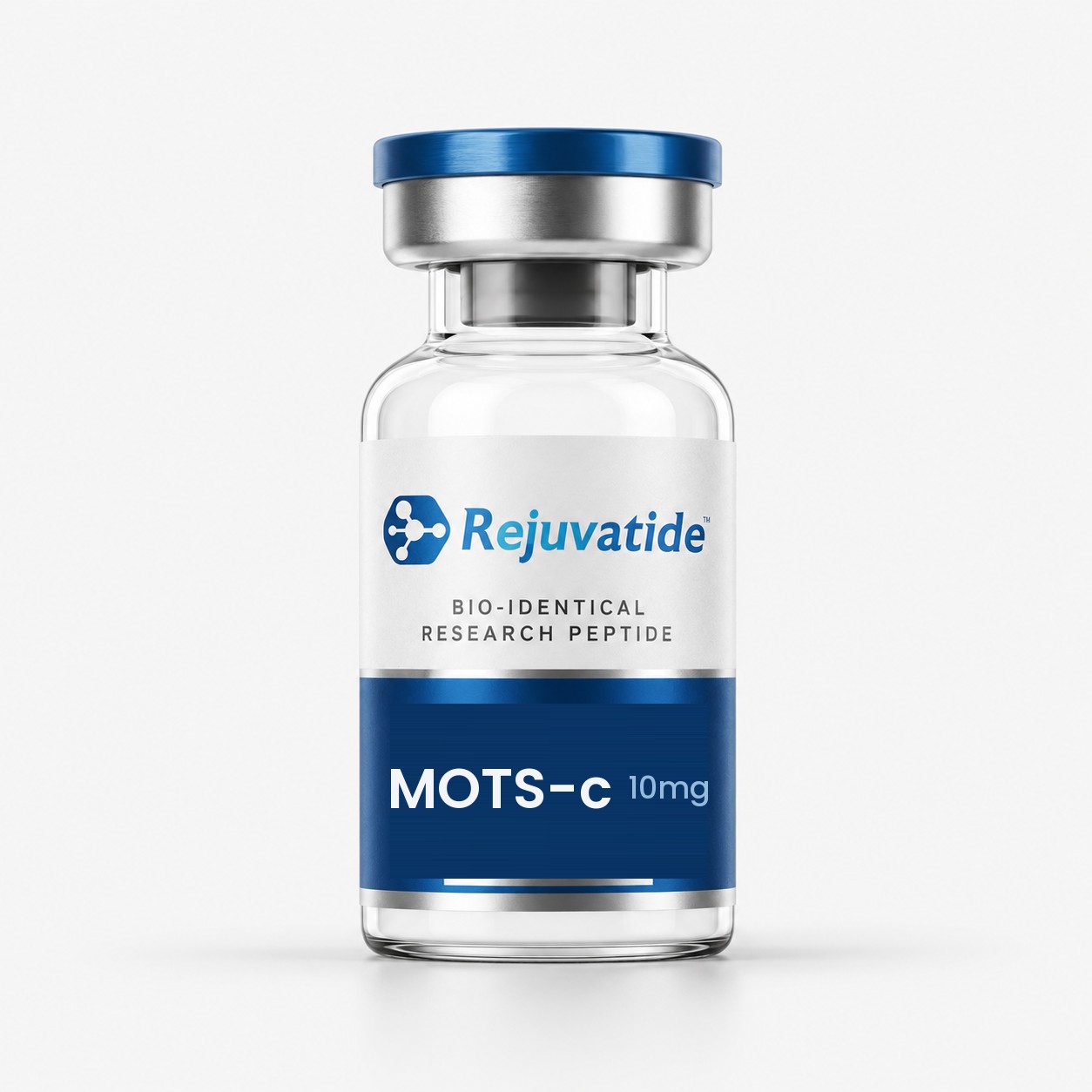
Rejuvatide supplies MOTS-c strictly as a research chemical for in vitro and laboratory use. It is not sold for human or veterinary use.
Testing and quality
Every Rejuvatide lot of MOTS-c is tested by an independent laboratory for purity by HPLC and identity by LC-MS, and the lot also carries an endotoxin certificate. The current certificates are shown below and in our COA library, where you can match the lot number on your vial to its report. Certificates are published exactly as the laboratory issued them.
For another mitochondria-focused research compound, see SS-31, or the coenzyme NAD+. Browse all related research compounds, or see our FAQ for ordering questions.
Storage of lyophilized material
MOTS-c ships as a lyophilized (freeze-dried) powder. For long-term storage, keep sealed vials at -20°C, protected from light and moisture. Allow a vial to reach room temperature before opening to limit condensation. Handling of any prepared solutions should follow your laboratory's own validated procedures.