Research overview
CJC-1295 No DAC + Ipamorelin: what the research shows
What is this blend?
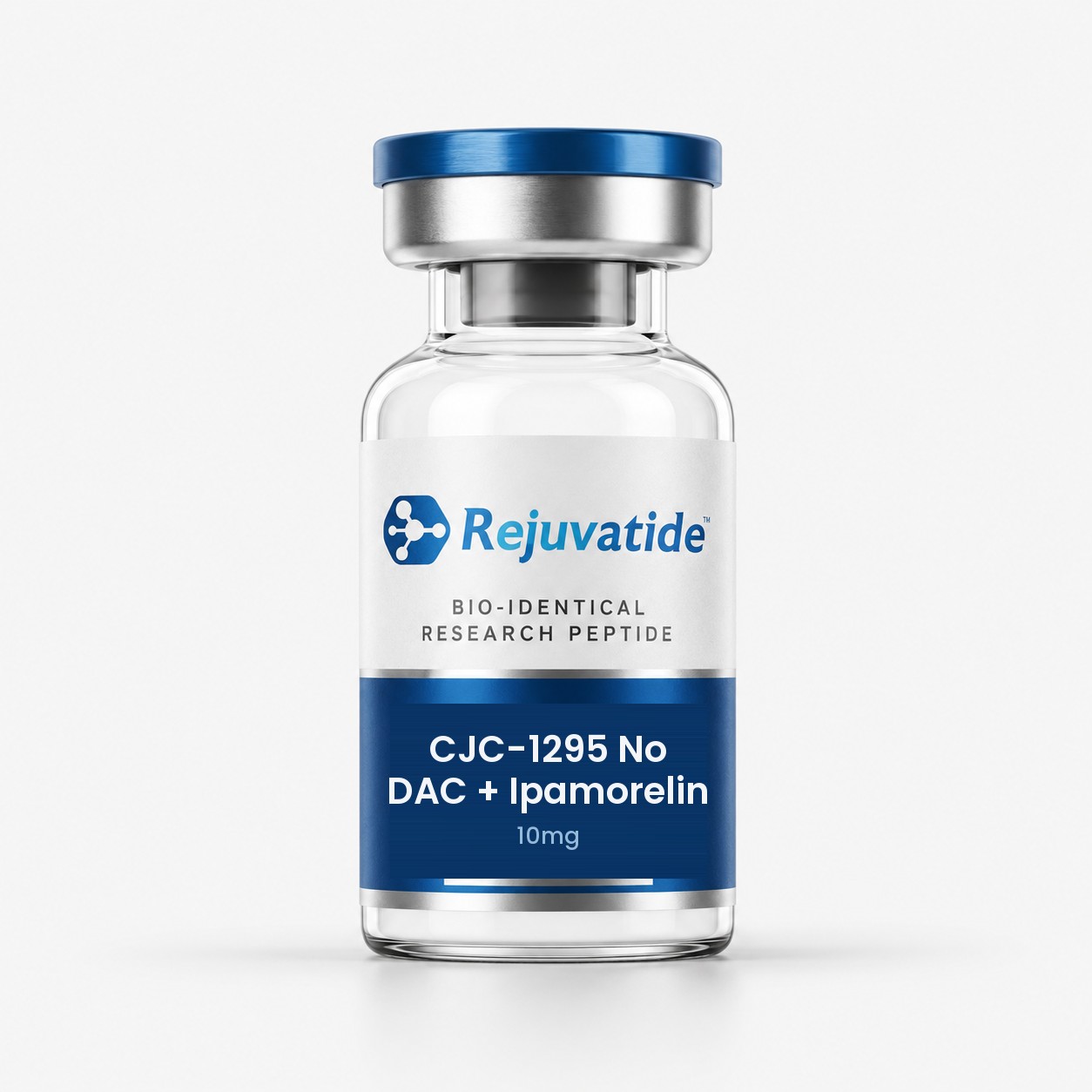
This product combines two research peptides that act on different receptors in the growth hormone (GH) axis: CJC-1295 No DAC, an analog of growth hormone-releasing hormone (GHRH), and ipamorelin, a selective agonist of the ghrelin receptor. Each vial holds 5mg of each peptide as a single lyophilized powder.
It is offered as a convenience format for laboratories that already study both compounds. Its components are sold individually as CJC-1295 No DAC and ipamorelin, and researchers who need independent control of each compound, or single-agent arms, should use those instead.
The published research on this exact two-compound combination is limited. The sections below summarize what is known about each component and are explicit about what has not been studied.
| Composition | CJC-1295 No DAC 5mg + ipamorelin 5mg per vial (lyophilized) |
|---|---|
| CJC-1295 No DAC: description | Tetrasubstituted hGRF(1-29) amide, 29 residues, without the maleimidopropionyl lysine of the DAC form (no PubChem compound record) |
| CJC-1295 No DAC: target | GHRH receptor |
| Ipamorelin: sequence | Aib-His-D-2-Nal-D-Phe-Lys-NH2 |
| Ipamorelin: formula and weight | C38H49N9O5, 711.9 g/mol |
| Ipamorelin: CAS and PubChem CID | 170851-70-4; CID 9831659 |
| Ipamorelin: target | Ghrelin receptor (GHS-R1a) |
The two components
CJC-1295 No DAC
CJC-1295 with DAC was characterized in 2005 as a tetrasubstituted form of hGRF(1-29) with an added C-terminal lysine carrying a maleimidopropionamide group that binds serum albumin [1]. The "No DAC" form lacks that albumin-binding lysine. A Norwegian doping-control laboratory reported in 2010 that a preparation sold under the CJC-1295 name contained a 29-amino-acid peptide with a C-terminal amide, illustrating that the non-DAC form circulates under the same name [2]. Anti-doping chemists handle "CJC-1295" and "CJC-1295 with drug affinity complex" as distinct analytes [3]. Without albumin binding, the non-DAC form would not be expected to share the extended persistence reported for the DAC form; we found no peer-reviewed pharmacokinetic study of the non-DAC form itself.
Ipamorelin
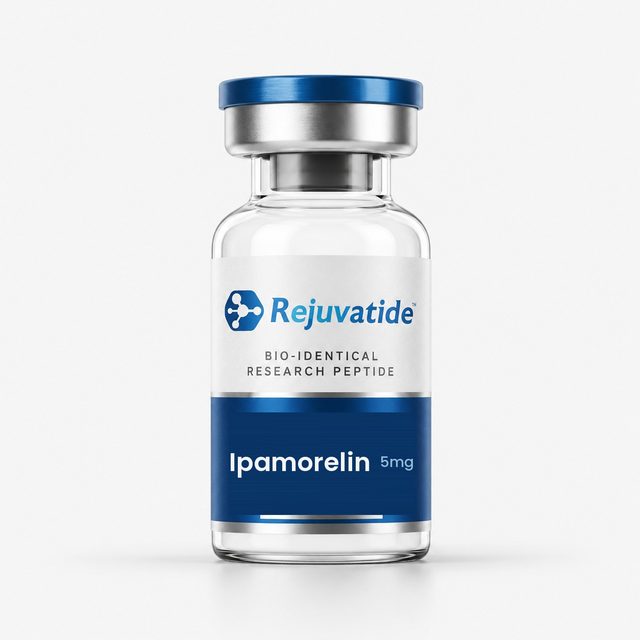
Ipamorelin is a synthetic pentapeptide, Aib-His-D-2-Nal-D-Phe-Lys-NH2, described in 1998 as the first GH secretagogue with a selectivity for GH release similar to that of GHRH. In swine it did not raise ACTH or cortisol beyond the levels seen after GHRH, whereas GHRP-2 and GHRP-6 did [4] [5]. See the ipamorelin research page for its full literature.
Two receptors, two pathways
The scientific rationale for studying these compounds side by side is that GH release from the pituitary is regulated through more than one receptor system.
- GHRH receptor. GHRH is synthesized in the hypothalamus and binds receptors on pituitary somatotroph cells to promote GH synthesis and release [6]. CJC-1295 analogs are built on the hGRF(1-29) fragment of GHRH [1].
- Ghrelin receptor. A distinct G protein-coupled receptor in the pituitary and hypothalamus, cloned in 1996, is the target of synthetic GH secretagogues [7]. Its endogenous ligand, ghrelin, was identified in 1999, and its discoverers noted that GH release may therefore be regulated not only by hypothalamic GHRH but also by ghrelin [8].
The two systems are linked rather than independent. In rats, the GH response to the ghrelin-receptor agonist GHRP-2 was absent after hypophysectomy and reduced after median eminence lesions, indicating that endogenous GHRH input was needed for the full response [9]. In GHRH knockout mice, long-term GHRP-2 exposure failed to stimulate GH secretion or somatotroph proliferation [10]. These findings come from GHRP-2, not ipamorelin, and they describe how the pathways depend on each other; they do not show what a fixed combination of these two specific compounds does.
What has and has not been studied
Being clear about the gaps matters for this product:
- No combination studies identified. We found no peer-reviewed study in PubMed that tested CJC-1295 No DAC and ipamorelin together. Claims elsewhere that the two are "synergistic" are not supported by published data on this combination, and Rejuvatide makes no such claim.
- Component data are uneven. Ipamorelin has published animal pharmacology, a human pharmacokinetic study, and a phase 2 trial in postoperative ileus that found no significant difference from placebo on its efficacy measures [11] [12]. The published human pharmacology for CJC-1295 concerns the DAC form, not the non-DAC component in this vial [13].
- Unregulated use. A 2026 narrative review of GH-axis peptides used outside medical supervision listed both CJC-1295 without DAC and ipamorelin, highlighted uncertainty about product composition, and described a gap between the clinical evidence and unsupervised use [14].
Any research use of the blend should be designed with that limited evidence base in mind, ideally alongside single-component controls.
Regulatory status
- Not FDA approved. A search of Drugs@FDA on October 12, 2026 returned no approved drug product containing CJC-1295 or ipamorelin [15].
- Compounding. FDA's list of bulk drug substances that may present significant safety risks (content current as of April 22, 2026) places ipamorelin acetate in category 2 under the 503B interim policy (added September 29, 2023) and lists CJC-1295 among substances whose nominations were withdrawn, with FDA noting immunogenicity risk and reported serious adverse events for both [16].
- Sport. The World Anti-Doping Agency 2026 Prohibited List names CJC-1295 (among GHRH analogues) and ipamorelin (among growth hormone secretagogues) under S2.2.4, growth hormone releasing factors, within class S2, which is prohibited at all times [17].
Status checked October 12, 2026. Rejuvatide supplies this blend strictly as a research chemical for in vitro and laboratory use. It is not sold for human or veterinary use.
Testing and quality
This blend is tested as a finished product by an independent laboratory, with identity confirmed for both components by LC-MS and purity by HPLC, and it is also tested for endotoxin. The current certificates are shown below and in our COA library, where you can match the lot number on your vial to its report. Certificates are published exactly as the laboratory issued them.
Single-component material for control arms: CJC-1295 No DAC and ipamorelin. For the long-acting albumin-binding analog, see CJC-1295 with DAC. Browse all growth-axis research peptides.
Storage of lyophilized material
This blend ships as a lyophilized (freeze-dried) powder, which is stable at ambient temperature during transit. For long-term storage, keep sealed vials at -20°C, protected from light and moisture. Allow a vial to reach room temperature before opening to limit condensation. Handling of any prepared solutions should follow your laboratory's own validated procedures.