Research overview
GHK-Cu: what the research shows
What is GHK-Cu?
GHK-Cu is the copper(II) complex of the tripeptide glycyl-L-histidyl-L-lysine (GHK) [1] [2]. The peptide was first reported in 1973 by Loren Pickart and Martin Thaler as a tripeptide in human serum that prolonged the survival of normal liver cells in culture [3]. In 1980, Pickart and colleagues reported that the tripeptide co-isolated with copper, readily formed complexes with copper(II), and increased copper uptake into cultured hepatoma cells, and proposed that it may act as a copper transport factor [4].
GHK has been reported in human plasma, saliva, and urine, and a 2015 review stated that its levels decline with age [11]. A 1988 study pointed out that the GHK sequence also occurs within the alpha 2(I) chain of type I collagen, and suggested that the tripeptide could be released by proteases at a wound site [6].
GHK-Cu has two parallel literatures: laboratory and animal research on tissue remodeling and gene expression, and a separate body of cosmetic-formulation work under its ingredient name, copper tripeptide-1. This page reports the research literature and explains below why the two should not be conflated. For a broader overview, see our article GHK-Cu peptide research.
| Sequence | Gly-His-Lys (GHK) complexed with copper(II) |
|---|---|
| Length | 3 amino acids (tripeptide) plus one Cu(II) ion |
| Molecular formula | C14H23CuN6O4+ (1:1 complex, PubChem); free GHK peptide C14H24N6O4 |
| Molecular weight | 402.92 g/mol (1:1 complex); 340.38 g/mol (free GHK) |
| CAS number | 89030-95-5 (copper complex); 49557-75-7 (free GHK) |
| PubChem CID | 71587328 (copper complex); 73587 (free GHK) |
| Other names | Copper tripeptide-1 (INCI name), prezatide copper, GHK copper (PubChem synonyms) |
Copper binding and chemistry
A 2011 structural study used X-ray crystallography and a range of spectroscopic methods to characterize the Cu(II) complex. It reported that Cu(II)-GHK is dimeric in the solid state but forms a monomeric complex in solution, with copper bound by three nitrogen ligands (the N-terminal amine, a deprotonated amide nitrogen, and the histidine imidazole) and a fourth, labile site. The authors also found fast copper exchange, which they attributed to a bis-complex in which two GHK molecules share one copper ion, and reported that the complex was redox-inert under moderate potentials [5].
This chemistry is relevant to research design. PubChem holds separate records for the free peptide and the 1:1 copper complex [1] [2], and the ratio of peptide to copper in a given preparation affects what is actually being studied.
Areas of research
Collagen and extracellular matrix in fibroblast culture
In a 1988 study in fibroblast cultures, GHK-Cu stimulated collagen synthesis starting at picomolar concentrations and peaking at about 1 nanomolar, without any change in cell number [6].
Rat wound-chamber models
In a 1993 study, stainless steel mesh chambers were implanted under the skin of rats, and GHK-Cu or saline was delivered into the chambers. GHK-Cu produced a concentration-dependent increase in dry weight, DNA, total protein, collagen, and glycosaminoglycans, with type I and type III collagen mRNAs increased but not TGF-beta mRNA. A control tripeptide had no significant effect [7]. A follow-up study in the same model reported increased type I collagen and glycosaminoglycans, enhanced accumulation of chondroitin sulfate and dermatan sulfate, and different regulation of the proteoglycans decorin and biglycan; decorin expression also rose in rat dermal fibroblast cultures [8].
Gene-expression research
A 2012 study profiled gene expression in lung tissue from smokers with COPD and identified 127 genes associated with regional emphysema severity. Using the Connectivity Map, a database of drug-induced expression profiles, the authors identified GHK as a compound predicted to reverse that signature. In human lung fibroblasts, GHK reproduced TGF-beta-like expression patterns, organized the actin cytoskeleton, raised integrin beta-1 expression, and restored collagen I gel contraction and remodeling by fibroblasts from COPD lungs [9]. Later reviews by Pickart and colleagues have discussed GHK's broader gene-expression effects; a 2015 review stated that it can up- and down-regulate at least 4,000 human genes [11] [12]. That figure is a count of gene-expression changes, not a measurement of effects in living tissue.
Inflammation models
A 2016 study examined GHK-Cu in LPS-stimulated RAW 264.7 mouse macrophages and in a mouse model of LPS-induced acute lung injury. The authors reported lower reactive oxygen species, higher superoxide dismutase activity, and lower TNF-alpha and IL-6 production, linked to suppression of NF-kappaB p65 and p38 MAPK signaling, along with reduced inflammatory-cell infiltration and fewer histological changes in the lungs [17].
Ligament graft model
In a 2015 rat model of anterior cruciate ligament reconstruction with 72 animals, GHK-Cu groups showed less knee laxity and higher graft stiffness than saline at 6 weeks, but no significant differences at 12 weeks or in ultimate load, gait, or histology. The authors concluded that the effect was transient and did not last once exposure stopped [10].
Open research questions
- Which effects require copper, and which are seen with the free peptide, given the fast copper exchange of the complex [5].
- How the gene-expression signatures identified computationally translate into effects in whole tissues [9].
- How durable the effects reported in animal models are, given the transient findings in the rat ligament model [10].
Cosmetic literature versus research
GHK-Cu is listed in PubChem under the cosmetic ingredient (INCI) name copper tripeptide-1, and its listed synonyms include names of commercial skin-care products [1]. Reviews by Pickart and colleagues summarize outcomes reported for cosmetic formulations alongside laboratory findings [11].
We keep these apart for two reasons. First, cosmetic studies evaluate finished topical products against appearance-based endpoints, a different question from how the compound behaves as a research reagent. Second, this site sells GHK-Cu only for laboratory research. We therefore do not describe cosmetic, skin, or hair outcomes, and nothing on this page is a claim about appearance or personal use.
State of the human evidence
Most GHK-Cu research is in cells and animals. The main human data come from cosmetic-formulation studies of topical products, which we do not summarize for the reasons above. FDA's own entry on GHK-Cu notes that there are limited data in humans to inform safety considerations [13].
Much of the review literature has been written by the scientist who first described the peptide and his collaborators [11] [12]. Findings from cell and animal models should not be read as evidence of safety or benefit in people.
Regulatory status
- Not FDA approved. GHK-Cu is not an FDA-approved drug; we found no approved drug containing it in Drugs@FDA (checked October 12, 2026) [16].
- FDA safety-risks page. FDA's page of bulk drug substances that may present significant safety risks (content current as of April 22, 2026) lists GHK-Cu, limited to certain routes of administration, among substances whose nominations were withdrawn by the nominators. The entry states that compounded drugs containing GHK-Cu for those routes may pose risk for immunogenicity due to potential aggregation and peptide-related impurities, and that there are limited data in humans to inform safety considerations [13].
- 503A nominations. FDA's 503A bulk substances list (updated May 14, 2026) places GHK-Cu for other routes of administration in category 1, under evaluation, after one nominator clarified on May 5, 2026 that it wished to keep that part of its nomination. FDA stated it intends to consult its Pharmacy Compounding Advisory Committee about GHK-Cu before the end of February 2027 [14] [15]. Category 1 status is not an approval.
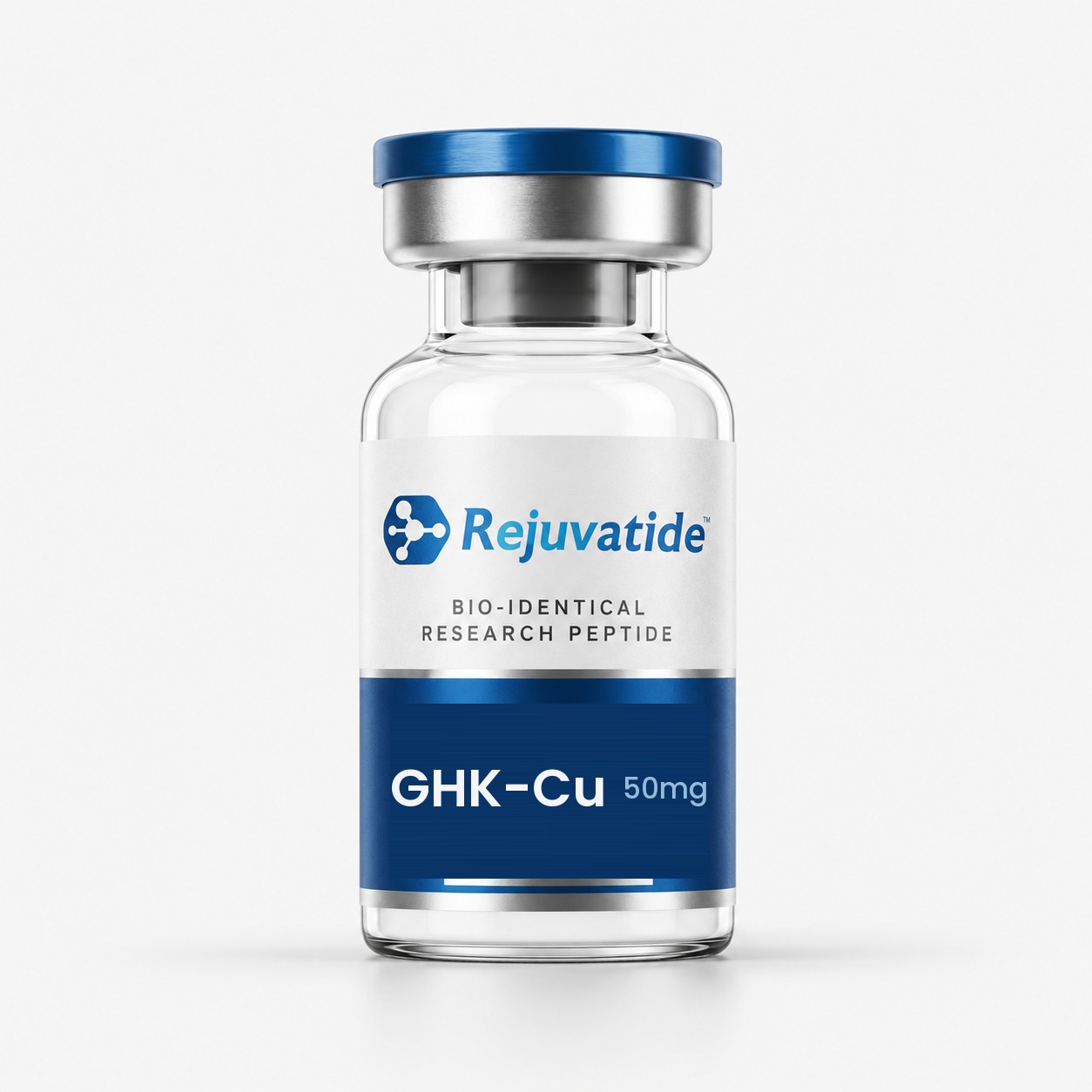
Rejuvatide supplies GHK-Cu strictly as a research chemical for in vitro and laboratory use. It is not sold for human or veterinary use, or as a cosmetic ingredient.
Testing and quality
The current lot of Rejuvatide GHK-Cu was tested by an independent laboratory for purity by HPLC and identity by LC-MS, and the certificate also reports USP <85> endotoxin testing, with a separate endotoxin certificate for the same lot. The certificates are shown below and in our COA library, where you can match the lot number on your vial to its report. Certificates are published exactly as the laboratory issued them.
GHK-Cu is also a component of our research blends Glow Blend, Klow Blend, and Wolverine Blend. Browse all pigmentation and signaling research peptides.
Storage of lyophilized material
GHK-Cu ships as a blue lyophilized (freeze-dried) powder. For long-term storage, keep sealed vials at -20°C, protected from light and moisture. Allow a vial to reach room temperature before opening to limit condensation. Handling of any prepared solutions should follow your laboratory's own validated procedures.