Research overview
TB-500: what the research shows
What is TB-500?
TB-500 is a name used in the research-peptide and anti-doping literature for synthetic material related to thymosin beta-4 (Tβ4), a small, highly conserved protein found in nearly all cells and body fluids. Thymosin beta-4 is the main actin-sequestering molecule in eukaryotic cells: it binds monomeric (G-) actin and keeps it from polymerizing into filaments [3] [4].
PubChem indexes TB-500 as a seven-residue peptide, Ac-LKKTETQ, which reproduces residues 17 to 23 of thymosin beta-4 with an acetyl group added to its N-terminus [1]. Anti-doping laboratories that analyzed products sold as TB-500 identified this acetylated fragment as the key ingredient [5] [6]. That stretch of the parent protein includes its central actin-binding domain, which earlier work linked to cell migration and wound-repair activity [4].
TB-500 is frequently studied alongside BPC-157, but the two are unrelated molecules. BPC-157 is a 15-residue fragment of a gastric protein; see our BPC-157 research peptide page and the BPC-157 research overview for that compound.
For a longer introduction to TB-500 and thymosin beta-4 research, read our TB-500 research article.
| TB-500 as indexed by PubChem | Ac-Leu-Lys-Lys-Thr-Glu-Thr-Gln-OH (Ac-LKKTETQ), the N-acetylated 17-23 fragment of thymosin beta-4 |
|---|---|
| TB-500 molecular formula | C38H68N10O14 |
| TB-500 molecular weight | 889.0 g/mol |
| TB-500 PubChem CID | 62707662 (CAS 885340-08-9 listed as a PubChem synonym) |
| Parent protein | Thymosin beta-4 (Tβ4), 43 amino acids, N-terminally acetylated |
| Parent protein sequence | Ac-SDKPDMAEIEKFDKSKLKKTETQEKNPLPSKETIEQEKQAGES |
| Parent protein formula and weight | C212H350N56O78S, 4963 g/mol (PubChem CID 16132341, CAS 77591-33-4) |
| Identity on current lot certificate | Thymosin beta-4 (mass identification reported by the testing laboratory) |
TB-500 versus thymosin beta-4
The name TB-500 is not used consistently. PubChem and the doping-control studies above describe it as the acetylated 17-23 fragment [1] [5] [6], while some research papers and commercial sources use "TB-500" for synthetic full-length thymosin beta-4. A 2026 rat tendon study, for example, described its test material as "synthetic thymosin beta-4 (TB-500)" without giving a sequence in its abstract [10]. A 2026 review of approved and unapproved peptides treated thymosin beta-4 and TB-500 as separate entries and described TB-500 as a thymosin beta-4 fragment [14].
This matters for interpreting the literature. Most published biology, including nearly all of the mechanism and tissue-repair work summarized below, was done with full-length thymosin beta-4, not with the seven-residue fragment. Findings for the 43-residue protein cannot automatically be attributed to Ac-LKKTETQ, and the reverse is also true. In the identity table above, thymosin beta-4 data are labeled as the parent protein for that reason.
We also state plainly what our own certificate says: the independent laboratory certificate for the current Rejuvatide TB-500 lot reports the mass identification of the material as thymosin beta-4. Researchers who need a specific sequence for their work should review the certificate in the testing section below before purchase.
Mechanisms studied
The mechanisms below were described for thymosin beta-4 or for short peptides derived from it. None has been confirmed in humans.
Actin sequestration
In 1991, researchers showed that "Fx," an acidic 5 kDa peptide bound to most of the unpolymerized actin in resting human platelets, had an amino acid sequence identical to thymosin beta-4. The purified protein formed a 1:1 complex with actin monomers and inhibited salt-induced actin polymerization, which suggested a broad role in regulating the actin cytoskeleton [3].
Active sites within the parent protein
A 2010 review mapped several functional regions within thymosin beta-4. It described an N-terminal tetrapeptide (Ac-SDKP) associated with anti-inflammatory and anti-fibrotic activity, a longer N-terminal region associated with cell survival, and a short sequence containing LKKTETQ (the central actin-binding domain, residues 17 to 23, plus one residue) associated with angiogenesis, wound healing, and cell migration [4]. Under this model, the TB-500 fragment would carry only one of the parent protein's proposed active sites.
Endothelial cell migration
In a 1997 study, thymosin beta-4 acted as a chemoattractant for human umbilical vein endothelial cells, increasing their migration four- to six-fold over medium alone in Boyden-chamber assays and accelerating closure of scratch wounds in cell monolayers. It also increased production of matrix metalloproteinases, and stimulated cell migration into Matrigel plugs in mice [7].
Integrin-linked kinase and Akt signaling
A 2004 study in mice reported that thymosin beta-4 formed a functional complex with PINCH and integrin-linked kinase (ILK), leading to activation of the survival kinase Akt. In cultured embryonic and postnatal cardiomyocytes it promoted migration and survival, and after coronary artery ligation in mice it increased ILK and Akt activity in heart tissue [11].
Metabolism of the fragment
A 2024 study is one of the few to examine TB-500 itself. The authors noted that the biological effects of acetylated TB-500 had not been documented, and studied its breakdown in human serum, in vitro enzyme systems, and rats. Ac-LK was the main metabolite in rats over the first six hours, and Ac-LKK was still detectable up to 72 hours. Neither the parent peptide nor its metabolites was cytotoxic to fibroblasts, and in a fibroblast wound-healing assay only one metabolite, Ac-LKKTE, showed a significant effect compared with control [9].
Areas of research
Dermal wound models
In a 1999 rat full-thickness wound model, thymosin beta-4 increased re-epithelialization compared with saline controls at days 4 and 7, with greater wound contraction, collagen deposition, and angiogenesis. The protein also stimulated keratinocyte migration in vitro [8]. A 2003 study extended this work to db/db diabetic mice and aged mice, models in which healing is delayed. In the aged mice, a synthetic seven-residue peptide containing the actin-binding domain, LKKTETQ, promoted repair comparable to the parent molecule [2]. That study is one of the few direct comparisons of the fragment with the full protein; note that it used the non-acetylated sequence.
Tendon models
A 2026 exploratory study in 32 rats with surgically repaired Achilles tendons compared controls with BPC-157, TB-500, and the two combined. At four weeks the authors reported higher maximum load to failure in the TB-500 group, lower histological degeneration scores, and changes in collagen organization. The combined group did not show an additional effect over either peptide alone. The authors called the findings preliminary and noted that the abstract described the test material as synthetic thymosin beta-4 [10].
Cardiac and vascular models
Beyond the ILK study [11], a 2007 study in mice identified thymosin beta-4 as essential for coronary vessel development, and reported that it stimulated outgrowth from quiescent adult epicardial explants, triggering differentiation into fibroblasts, smooth muscle cells, and endothelial cells [12].
Hair follicle models
In 2004, researchers reported that thymosin beta-4 increased hair growth in rats and mice, and that it increased migration and differentiation of clonogenic follicle keratinocytes in culture along with secretion of matrix metalloproteinase-2 [13].
Open research questions
- Whether the acetylated fragment reproduces the activities reported for full-length thymosin beta-4, which has been tested directly in very few studies [2] [9].
- How rapid metabolism of the fragment into shorter peptides affects activity in experimental systems [9].
- Long-term effects of sustained pro-migratory and pro-angiogenic signaling, since the same processes also take part in pathological tissue growth.
- Consistent naming, so that results reported for "TB-500" can be traced to a defined sequence.
State of the human evidence
We did not find published controlled human trials of TB-500 (the acetylated 17-23 fragment) in PubMed as of the review date, and FDA states that it has no human exposure data for this substance (see regulatory status below) [17].
The parent protein has some clinical history. A 2010 randomized, placebo-controlled study in healthy volunteers (four cohorts of ten) evaluated single and repeated administration of synthetic thymosin beta-4 for 14 days; adverse events were infrequent and mild or moderate, with no serious adverse events reported [15]. A 2021 first-in-human phase I study of a recombinant human thymosin beta-4 in healthy Chinese volunteers reported similar tolerability findings [16]. A 2015 review described clinical trials of thymosin beta-4, completed or planned at the time, in eye injury, dermal wound, and cardiac settings [18].
None of this work used TB-500 as indexed by PubChem, and none establishes safety or benefit for any research material sold under that name. A 2026 review noted that rigorous human safety data for unapproved peptides in this group are scarce [14]. Animal and cell findings should not be read as evidence of safety or benefit in people.
Regulatory status
- Not FDA approved. TB-500 is an unapproved peptide. It is not approved by the U.S. Food and Drug Administration for any human use, and the compounding vote described below does not make it an approved drug [21].
- Compounding. FDA's list of bulk drug substances that may present significant safety risks (current as of April 22, 2026) includes "Thymosin beta-4, fragment (LKKTETQ), also known as TB-500" among substances whose nominations were withdrawn. FDA notes that compounded drugs containing it may pose a risk of immunogenicity for certain routes of administration, that it has no human exposure data, and that it lacks important information about safety issues [17].
- Advisory committee vote. At its July 23-24, 2026 meeting, FDA's Pharmacy Compounding Advisory Committee voted 8 in favor, 6 opposed, with 1 abstention, to recommend TB-500 for the 503A bulks list, evaluated for wound healing. FDA staff had recommended against adding the peptides reviewed. The vote is a non-binding recommendation, FDA is not bound by it, and FDA had not acted on it at the time of this review [19] [21].
- Sport. The World Anti-Doping Agency 2026 Prohibited List names "Thymosin-β4 and its derivatives e.g. TB-500" under S2.3, growth factors and growth factor modulators, in class S2 (peptide hormones, growth factors, related substances and mimetics) [20].
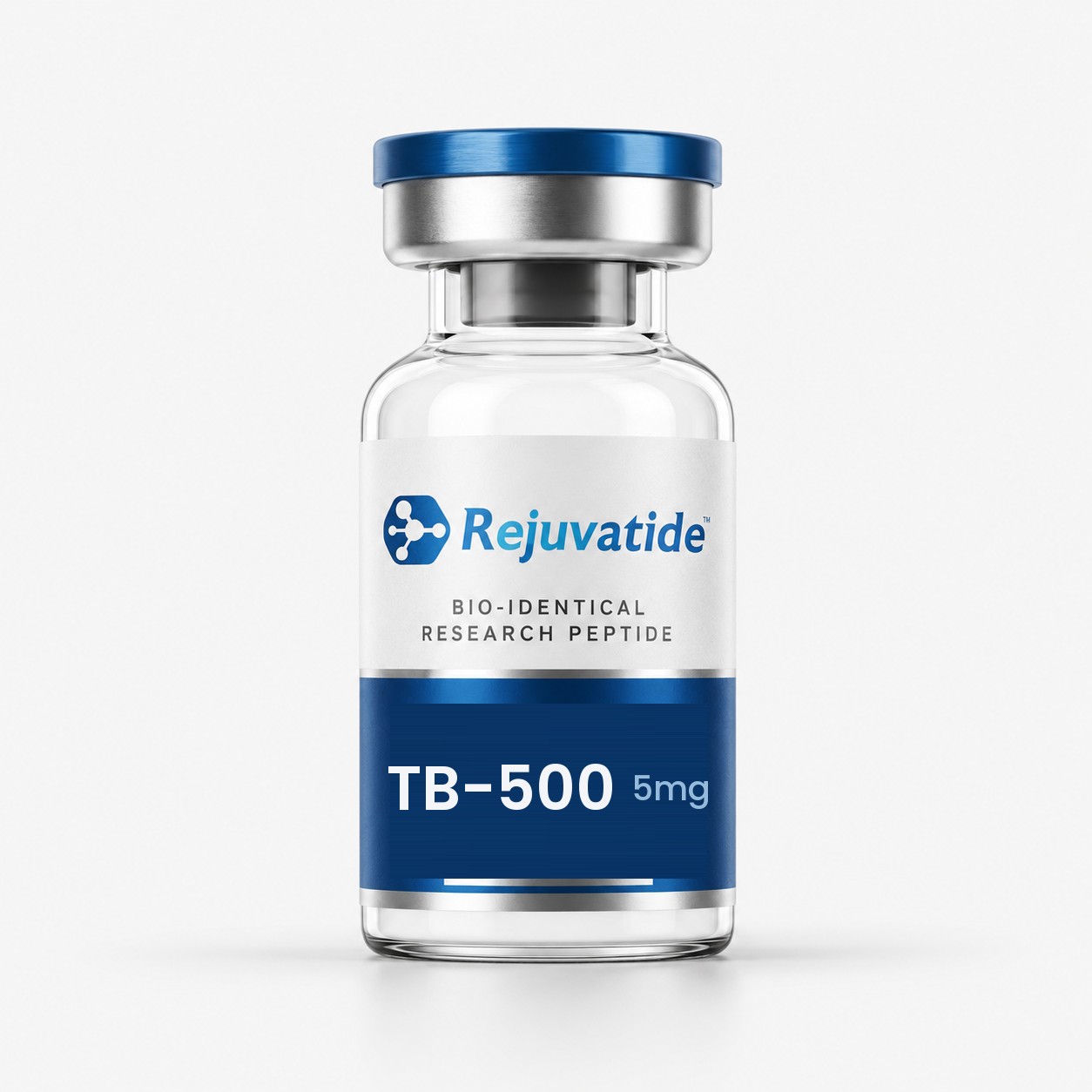
Rejuvatide supplies TB-500 strictly as a research chemical for in vitro and laboratory use. It is not sold for human or veterinary use.
Testing and quality
Rejuvatide TB-500 is tested by an independent laboratory for purity by HPLC with identity confirmed by mass spectrometry, and is also tested for endotoxin under USP <85>. The certificate for the current lot reports the mass identification as thymosin beta-4, as discussed above. Both certificates are shown below and in our COA library, where you can match the lot number on your vial to its report. Certificates are published exactly as the laboratory issued them.
TB-500 is also a component of our research blends: BPC-157 / TB-500 Blend, Glow Blend, Klow Blend, and Wolverine Blend. Browse all research peptides in this category.
Storage of lyophilized material
TB-500 ships as a lyophilized (freeze-dried) powder, which is stable at ambient temperature during transit. For long-term storage, keep sealed vials at -20°C, protected from light and moisture. Allow a vial to reach room temperature before opening to limit condensation. Handling of any prepared solutions should follow your laboratory's own validated procedures.