Research overview
Glow Blend: what the research shows
What is the Glow Blend?
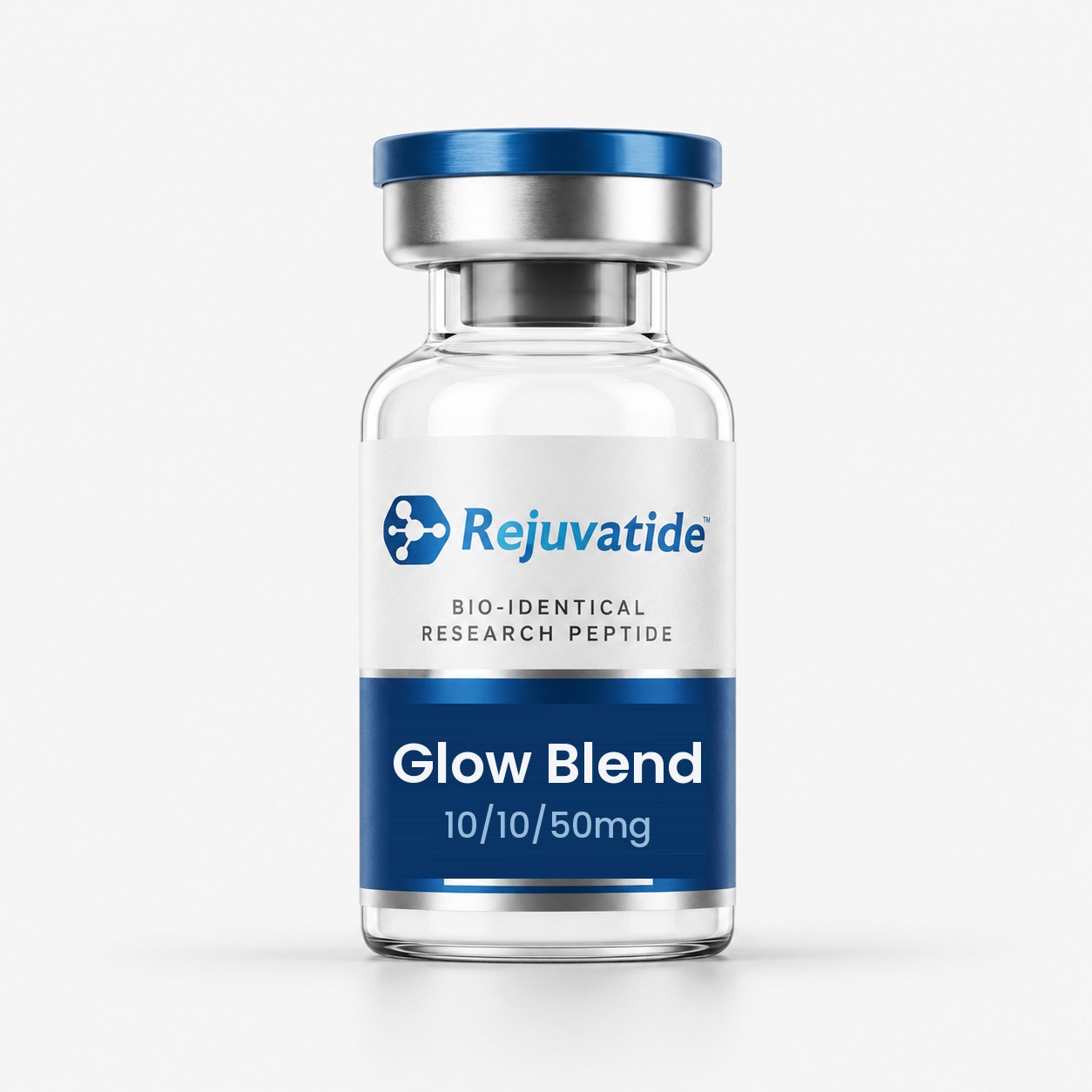
The Glow Blend is a single lyophilized vial containing three research peptides: BPC-157, TB-500, and the copper peptide GHK-Cu. Each component has its own research literature and its own page on this site: BPC-157, TB-500, and GHK-Cu.
Research on this specific three-peptide combination in one vial is limited. The published work concerns each peptide individually, and the summaries below describe those separate literatures. This page makes no claim that the three peptides interact, reinforce one another, or produce a combined effect.
| Component 1: BPC-157 | GEPPPGKPADDAGLV, 15 amino acids, C62H98N16O22, 1419.5 g/mol (PubChem CID 9941957) |
|---|---|
| Component 2: TB-500 | Indexed by PubChem as Ac-LKKTETQ, the acetylated 17-23 fragment of thymosin beta-4, C38H68N10O14, 889.0 g/mol (PubChem CID 62707662) |
| Component 3: GHK-Cu | Copper(II) complex of the tripeptide Gly-His-Lys (GHK); GHK peptide C14H24N6O4, 340.38 g/mol (PubChem CID 73587) |
| Form | Lyophilized powder, three peptides combined in a single vial |
| Labeled strength | 10/10/50mg |
The three components
BPC-157
BPC-157 is a synthetic 15-amino-acid peptide reproducing part of a protein first isolated from human gastric juice [1]. In rat tendon fibroblasts it increased migration and survival, linked to focal adhesion kinase and paxillin phosphorylation [4], and in endothelial and rodent models it was associated with VEGFR2-Akt-eNOS signaling [5]. A 2025 systematic review found the evidence almost entirely preclinical [6].
TB-500
TB-500 is associated with thymosin beta-4, a 43-residue actin-sequestering protein. PubChem indexes it as Ac-LKKTETQ, an acetylated copy of residues 17 to 23 of thymosin beta-4 [2], although the name is also used for synthetic full-length thymosin beta-4. A 2003 study in aged mice reported that a synthetic peptide containing the LKKTETQ actin-binding domain promoted dermal wound repair comparable to the full protein [7]. Findings for full-length thymosin beta-4 cannot automatically be attributed to the fragment; see the TB-500 page for detail.
GHK-Cu
GHK is a naturally occurring tripeptide, glycyl-L-histidyl-L-lysine, isolated from human plasma, with a high affinity for copper(II) ions [3] [8]. In a 1988 study, the copper complex GHK-Cu stimulated collagen synthesis in fibroblast cultures, with effects beginning at very low concentrations and independent of changes in cell number [8]. A 2015 review summarized reports that GHK modulated both synthesis and breakdown of collagen and glycosaminoglycans, and attracted immune and endothelial cells in injury models [9]. Our article on GHK-Cu peptide research covers this compound in more depth.
What is known about the combination
We did not find published studies of BPC-157, TB-500, and GHK-Cu combined in one preparation. The closest work is a 2026 rat Achilles tendon study that compared BPC-157, TB-500, and the two together; the combined group showed no additional improvement compared with either peptide alone, and the authors described the findings as preliminary [10]. That study did not include GHK-Cu and did not use a pre-combined vial.
No published study we found has characterized how these three peptides behave when stored together, including any effect of the copper complex on the other components. Human evidence is very limited for each component individually [6] [11], and nothing here should be read as evidence of safety or benefit in people.
Related reading: our BPC-157 research overview, and other compounds in our tissue-repair research category.
Regulatory status
- Not FDA approved. BPC-157 and TB-500 are unapproved peptides, not FDA-approved drugs [12]. This blend is not an approved drug.
- Compounding. FDA's list of bulk drug substances that may present significant safety risks (current as of April 22, 2026) includes BPC-157, the thymosin beta-4 fragment known as TB-500, and GHK-Cu (the GHK-Cu listing is limited to certain routes of administration) among withdrawn nominations. For each, FDA notes a possible risk of immunogenicity and limited or missing human safety information [11].
- Advisory committee vote. In July 2026, FDA's Pharmacy Compounding Advisory Committee voted 8 to 6, with 1 abstention, to recommend each of BPC-157 and TB-500 for the 503A bulks list, against the recommendation of FDA staff. GHK-Cu was not among the peptides reviewed at that meeting. The votes are non-binding, and FDA had not acted on them at the time of this review [12] [13].
- Sport. The World Anti-Doping Agency 2026 Prohibited List names BPC-157 under S0 and "Thymosin-β4 and its derivatives e.g. TB-500" under S2.3 [14].
Rejuvatide supplies the Glow Blend strictly as a research chemical for in vitro and laboratory use. It is not sold for human or veterinary use.
Testing and quality
The laboratory has not yet issued a certificate for the finished Glow Blend. Until it does, this page shows the current certificates for each component peptide, BPC-157, TB-500, and GHK-Cu, each tested by an independent laboratory for HPLC purity and mass-spectrometry identity and each with its own USP <85> endotoxin certificate. These certify the component peptides, not the blended vial. All certificates are published exactly as issued and listed in our COA library.
Storage of lyophilized material
The Glow Blend ships as a lyophilized (freeze-dried) powder, which is stable at ambient temperature during transit. For long-term storage, keep sealed vials at -20°C, protected from light and moisture. Allow a vial to reach room temperature before opening to limit condensation. Handling of any prepared solutions should follow your laboratory's own validated procedures.