Research overview
Wolverine Blend: what the research shows
What is the Wolverine Blend?
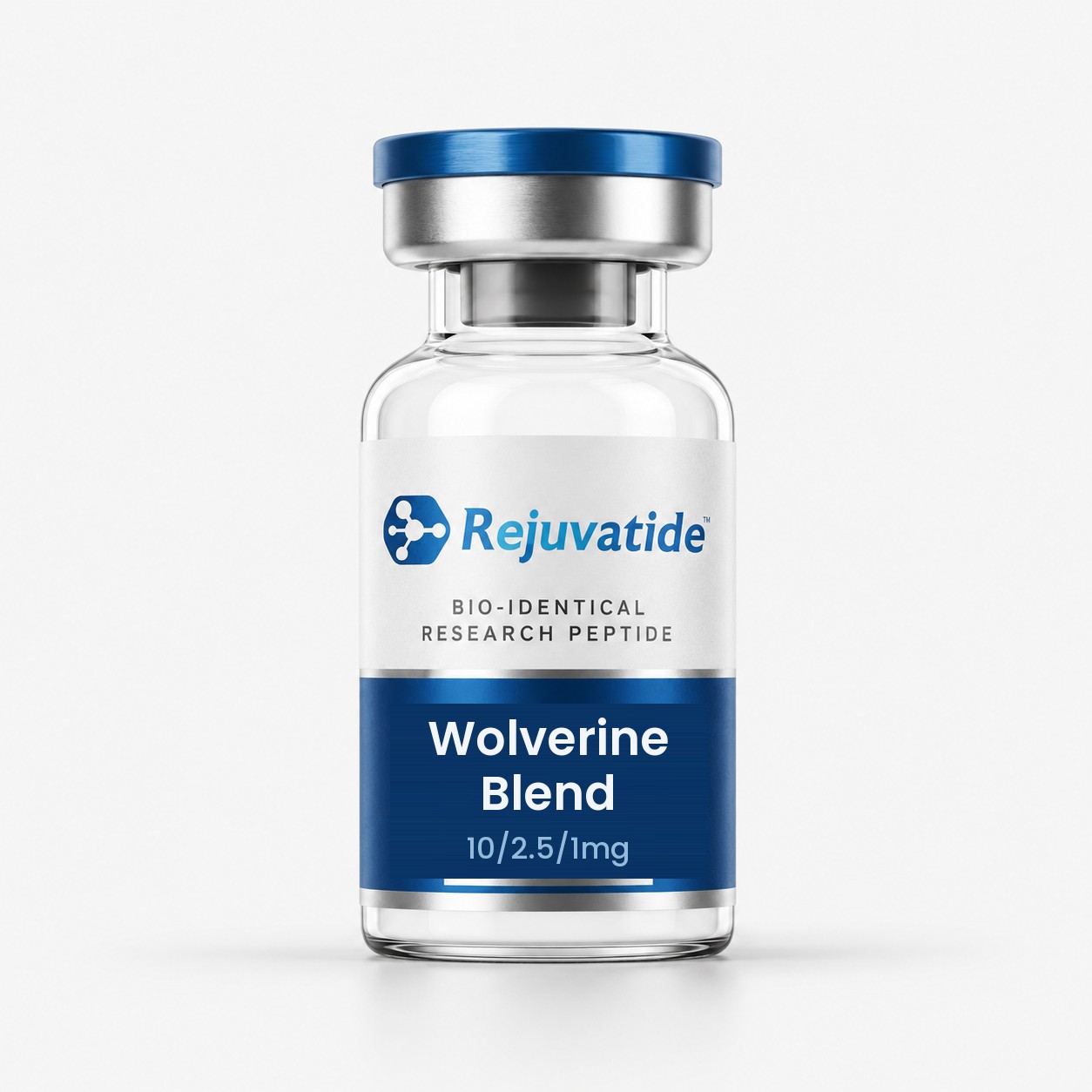
The Wolverine Blend contains BPC-157 and TB-500 together with the copper peptide GHK-Cu, combined in one lyophilized vial. It uses the same three peptides as our Glow Blend at a different, more compact labeled ratio. Each component has its own page: BPC-157, TB-500, and GHK-Cu.
Research on this specific combination in one vial is limited. The studies cited below were carried out on individual peptides, and this page makes no claim that the three components interact or produce a combined effect.
| Component 1: BPC-157 | GEPPPGKPADDAGLV, 15 amino acids, C62H98N16O22, 1419.5 g/mol (PubChem CID 9941957) |
|---|---|
| Component 2: TB-500 | Indexed by PubChem as Ac-LKKTETQ, the acetylated 17-23 fragment of thymosin beta-4, C38H68N10O14, 889.0 g/mol (PubChem CID 62707662) |
| Component 3: GHK-Cu | Copper(II) complex of the tripeptide Gly-His-Lys (GHK); GHK peptide C14H24N6O4, 340.38 g/mol (PubChem CID 73587) |
| Form | Lyophilized powder, three peptides combined in a single vial |
| Labeled strength | 10/2.5/1mg |
Connective-tissue research on each component
BPC-157 in tendon, ligament, and muscle models
BPC-157 is a synthetic 15-residue fragment of a protein first isolated from human gastric juice [1]. A 2019 review of tendon, ligament, and skeletal-muscle studies in animal models summarized favorable outcomes reported by the original authors, while noting that most work used small rodent models and came from a handful of research groups [4]. In cultured rat tendon fibroblasts, BPC-157 increased migration and survival without directly increasing proliferation [5].
TB-500 and thymosin beta-4
PubChem indexes TB-500 as Ac-LKKTETQ, an acetylated copy of residues 17 to 23 of the actin-binding protein thymosin beta-4 [2]; the name is also applied to synthetic full-length thymosin beta-4. A 2010 review located the parent protein's cell-migration and wound-healing activity in a short sequence containing LKKTETQ [6]. In a 2026 rat Achilles tendon study, a group given material the authors described as synthetic thymosin beta-4 (TB-500) showed higher load to failure than controls at four weeks [7]. Findings for the full protein cannot automatically be attributed to the fragment; see the TB-500 page.
GHK-Cu and extracellular matrix
GHK (glycyl-L-histidyl-L-lysine) is a tripeptide with high affinity for copper(II), isolated from human plasma [3] [8]. In fibroblast cultures, the copper complex stimulated collagen synthesis independent of changes in cell number [8]. A 2018 review summarized reports that GHK increased collagen, elastin, and glycosaminoglycan synthesis and supported dermal fibroblast function, and discussed gene-expression data proposed to explain its range of reported actions [9]. See also our GHK-Cu research article.
Limits of the evidence for this combination
We did not find published research on BPC-157, TB-500, and GHK-Cu together. The one study we found that combined BPC-157 and TB-500, the 2026 rat tendon study, reported that the two peptides given together did not produce an additional effect over either alone; it did not include GHK-Cu or a pre-combined vial [7].
There are also no published data we could find on the stability of these three peptides stored together. Human evidence is very limited for each component, and FDA reports limited or no human safety information for all three [10]. The findings above come from cell and animal models and should not be read as evidence of safety or benefit in people.
Further reading: our BPC-157 research overview and the full range of research peptides in this category.
Regulatory status
- Not FDA approved. BPC-157 and TB-500 are unapproved peptides, not FDA-approved drugs [11], and this blend is not an approved drug.
- Compounding. FDA's list of bulk drug substances that may present significant safety risks (current as of April 22, 2026) places BPC-157, the thymosin beta-4 fragment known as TB-500, and GHK-Cu (for certain routes of administration) among withdrawn nominations, each with a noted possible risk of immunogenicity [10].
- Advisory committee vote. In July 2026, FDA's Pharmacy Compounding Advisory Committee voted 8 to 6, with 1 abstention, to recommend each of BPC-157 and TB-500 for the 503A bulks list, against FDA staff's recommendation. GHK-Cu was not reviewed at that meeting. The votes are non-binding, and FDA had not acted on them at the time of this review [11] [12].
- Sport. The World Anti-Doping Agency 2026 Prohibited List names BPC-157 under S0 and "Thymosin-β4 and its derivatives e.g. TB-500" under S2.3 [13].
Rejuvatide supplies the Wolverine Blend strictly as a research chemical for in vitro and laboratory use. It is not sold for human or veterinary use.
Testing and quality
A certificate for the finished Wolverine Blend has not yet been issued by the laboratory. In the meantime, this page shows the current independent certificates for each component, BPC-157, TB-500, and GHK-Cu, covering HPLC purity and mass-spectrometry identity, each with a USP <85> endotoxin certificate. These certify the component peptides rather than the blended vial. All certificates are published as issued and listed in our COA library.
Storage of lyophilized material
The Wolverine Blend ships as a lyophilized (freeze-dried) powder, which is stable at ambient temperature during transit. For long-term storage, keep sealed vials at -20°C, protected from light and moisture. Allow a vial to reach room temperature before opening to limit condensation. Handling of any prepared solutions should follow your laboratory's own validated procedures.