Research overview
CJC-1295 with DAC: what the research shows
What is CJC-1295 with DAC?
CJC-1295 with DAC is a synthetic analog of growth hormone-releasing hormone (GHRH), the hypothalamic peptide that binds receptors on pituitary somatotroph cells to promote the synthesis and release of growth hormone [6]. It is built on hGRF(1-29), a 29-residue N-terminal fragment of human GHRH, and it was designed to address a practical limitation: the short half-life of GHRH [5].
The molecule was described in 2005 by researchers at ConjuChem. They synthesized three maleimido derivatives of hGRF(1-29) intended to attach covalently to the free thiol at cysteine 34 of serum albumin. The lead compound, CJC-1295, is a tetrasubstituted form of hGRF(1-29) with an added lysine at the C terminus that carries a 3-maleimidopropionamide group [2]. That reactive group is what the name "DAC" (drug affinity complex) refers to. PubChem's record for the compound describes it as a maleimido derivative of hGRF(1-29) [1].
The strategy behind the design, as the original authors described it, was in vivo bioconjugation to albumin as a way to extend plasma half-life [2]. This makes CJC-1295 with DAC a tool for studying sustained, rather than brief, GHRH receptor stimulation.
| Sequence | Tyr-D-Ala-Asp-Ala-Ile-Phe-Thr-Gln-Ser-Tyr-Arg-Lys-Val-Leu-Ala-Gln-Leu-Ser-Ala-Arg-Lys-Leu-Leu-Gln-Asp-Ile-Leu-Ser-Arg-Lys(maleimidopropionyl)-NH2 |
|---|---|
| Length | 30 residues: a 29-residue modified hGRF(1-29) sequence plus a C-terminal lysine carrying a maleimidopropionyl group |
| Molecular formula | C165H269N47O46 |
| Molecular weight | 3647.2 g/mol |
| CAS number | 446262-90-4 |
| PubChem CID | 91971820 |
| Other names | CJC 1295, CJC1295, GRF 1-29 (CJC1295) (PubChem synonyms) |
With DAC versus without DAC
The name "CJC-1295" is used for two different molecules, which causes real confusion in the literature and the research-chemical market:
- CJC-1295 with DAC (this product) carries the maleimidopropionyl lysine and is the compound characterized in the original ConjuChem work and the published pharmacology studies [2] [4].
- CJC-1295 without DAC, often sold as Mod GRF (1-29), lacks the albumin-binding group. A Norwegian doping-control laboratory reported in 2010 that a preparation sold under the CJC-1295 name contained a 29-amino-acid peptide with a C-terminal amide, rather than the DAC form [8].
Anti-doping chemists now handle the two as separate analytes. A 2021 study of in vitro metabolism listed "CJC-1295" and "CJC-1295 with drug affinity complex" as distinct GHRH analogs [9]. Researchers comparing data across papers or suppliers should confirm which form was used. Rejuvatide lists the two separately: this page covers the DAC form, and CJC-1295 No DAC covers the analog without the albumin-binding group.
Mechanisms studied
The proposed mechanism is straightforward receptor pharmacology. Published work has examined how albumin conjugation changes the behavior of a GHRH receptor agonist; none of it establishes a benefit in people.
GHRH receptor agonism in pituitary cells
In the 2005 characterization study, human serum albumin conjugates of all three maleimido hGRF(1-29) derivatives were bioactive in a growth hormone (GH) secretion assay using cultured rat anterior pituitary cells, confirming that the conjugated peptides still activated the GHRH receptor [2].
Resistance to DPP-IV cleavage
Short GHRH fragments are vulnerable to N-terminal cleavage; an anti-doping study detected a sermorelin metabolite lacking the first two residues, GHRH(3-29), in a human plasma sample [10]. In the CJC-1295 characterization study, the albumin conjugates showed enhanced in vitro stability against the enzyme dipeptidylpeptidase-IV [2].
Covalent albumin binding in vivo
In normal male Sprague Dawley rats, CJC-1295 produced an acute GH secretory response that exceeded that of hGRF(1-29), and the peptide was still present in plasma beyond 72 hours. A Western blot of rat plasma showed a CJC-1295 immunoreactive species on the band corresponding to serum albumin within 15 minutes, persisting beyond 24 hours [2].
Pulsatility under continuous stimulation
A question raised by any long-acting GHRH analog is whether continuous receptor stimulation disrupts the normal pulsatile pattern of GH secretion. A 2006 study that sampled blood every 20 minutes overnight reported that GH pulsatility was preserved, with unchanged pulse frequency, while trough (basal) GH levels rose [5]. The authors interpreted the trough increase as the main driver of the downstream IGF-I response.
Areas of research
Somatotroph biology in GHRH-deficient mice
The most informative animal model is the GHRH knockout mouse, which lacks endogenous GHRH and has a hypoplastic pituitary. In a 2006 study, GHRH knockout mice exposed to CJC-1295 from one week of age showed normal body weight and length at the end of five weeks under the most frequent exposure tested, while less frequent exposure produced only partial normalization. The authors also reported increased total pituitary RNA and GH mRNA, and immunohistochemistry consistent with proliferation of somatotroph cells [3]. This positions the compound as a tool for studying how sustained GHRH receptor signaling maintains the somatotroph population.
Biomarkers of GH-axis activation
Because CJC-1295 produces a sustained rise in GH and IGF-1, it has been used as an experimental stimulus to search for serum markers of GH action. A 2009 proteomic study compared serum samples from healthy adult men before and one week after exposure and identified several protein spots that changed, including isoforms of apolipoprotein A1 and transthyretin. The authors described these as potential biomarkers whose link to GH and IGF-1 biology remains to be clarified [6].
Analytical and anti-doping chemistry
A substantial share of recent CJC-1295 literature is analytical. Doping-control laboratories have developed liquid chromatography and mass spectrometry methods to detect GHRH analogs, including CJC-1295, in human urine and plasma [9] [10]. This work has also characterized in vitro metabolites that can serve as reference materials.
Open research questions
- How prolonged, non-pulsatile GHRH receptor exposure affects receptor expression and somatotroph function over longer periods in animal models.
- Whether findings in the GHRH knockout mouse apply to animals with an intact hypothalamic GHRH system.
- The identity of products sold under the CJC-1295 name, given the documented confusion between the DAC and non-DAC forms [8].
State of the human evidence
CJC-1295 with DAC is one of the few research peptides in this category that reached formal human pharmacology studies. In 2006, two randomized, placebo-controlled, double-blind ascending studies in healthy adults examined its pharmacokinetics, its effects on GH and IGF-I, and its safety [4]. A separate study examined GH pulsatility in healthy young men [5], and the proteomic biomarker study described above used samples from healthy men [6]. These were short pharmacology studies in small groups of volunteers, not efficacy trials for any condition.
Clinical development did not lead to an approved product. A 2026 narrative review of GH-axis peptides in circulation outside medical supervision grouped compounds by the quality of their human evidence and highlighted the uncertainty around product composition and the gap between published data and unsupervised use [7]. FDA has also noted reports of serious adverse events associated with CJC-1295 [11]. Findings from the studies above should not be read as evidence of safety or benefit in people.
Regulatory status
- Not FDA approved. A search of Drugs@FDA on October 12, 2026 returned no approved drug product containing CJC-1295 [12].
- Compounding. FDA's list of bulk drug substances that may present significant safety risks (content current as of April 22, 2026) places CJC-1295 among substances whose nominations were withdrawn. FDA's entry states that compounded drugs containing it may pose a risk of immunogenicity and may raise complexities with peptide-related impurities and characterization, notes reported serious adverse events including increased heart rate and a systemic vasodilatory reaction, and describes available clinical data as limited [11].
- Sport. The World Anti-Doping Agency 2026 Prohibited List names CJC-1295 under S2.2.4, growth hormone releasing factors (GHRH and its analogues), within class S2, which is prohibited at all times [13].
Status checked October 12, 2026. Rejuvatide supplies CJC-1295 with DAC strictly as a research chemical for in vitro and laboratory use. It is not sold for human or veterinary use.
Testing and quality
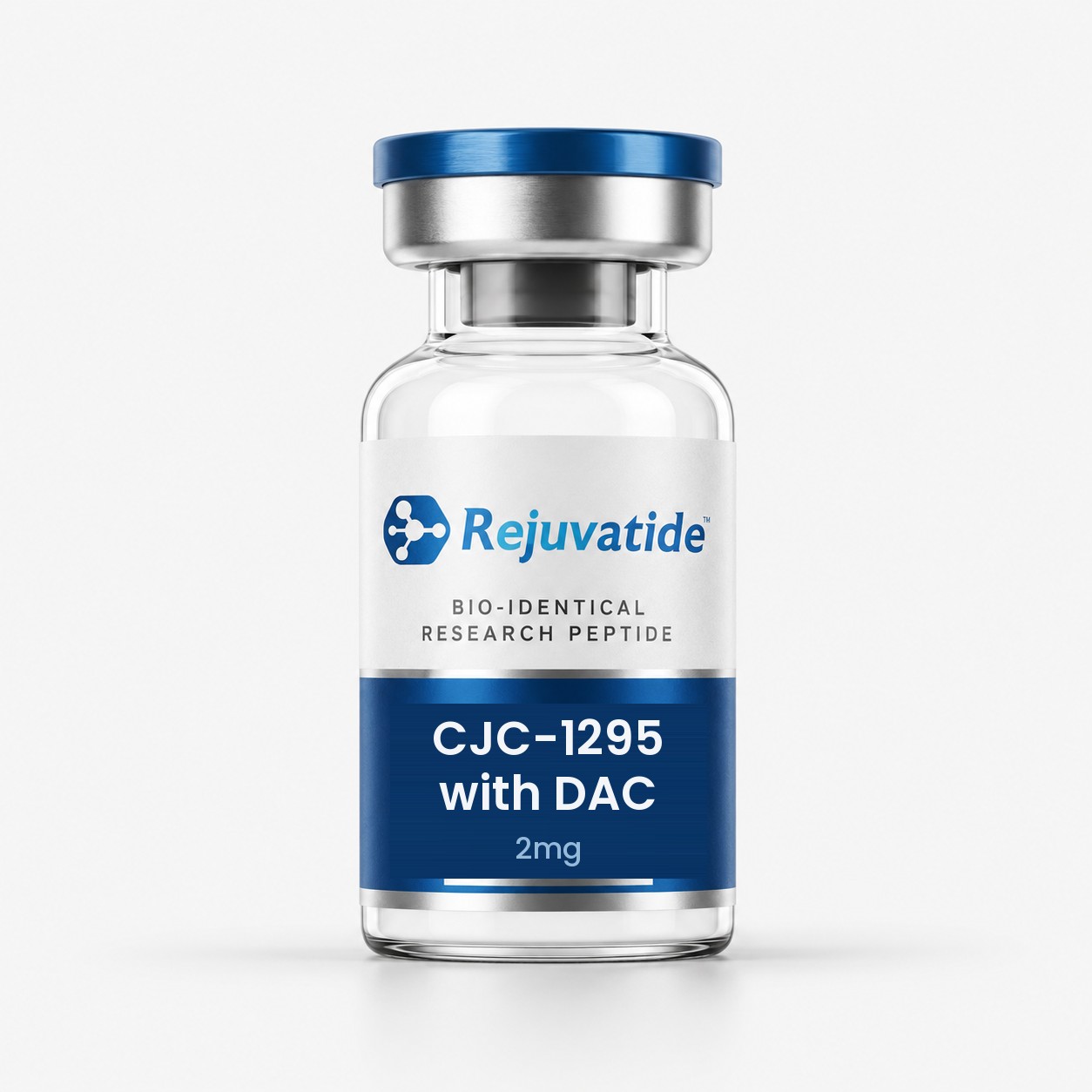
A certificate of analysis for the current lot of CJC-1295 with DAC can be requested through our COA library. When you compare a certificate to published work, check that the reported mass matches the DAC form (about 3647 Da per PubChem) rather than the shorter non-DAC peptide, since the two are often confused [1] [8].
Related GHRH-receptor research compounds include CJC-1295 No DAC and the CJC-1295 No DAC + Ipamorelin blend. Browse all growth-axis research peptides, or see our FAQ for ordering and shipping questions.
Storage of lyophilized material
CJC-1295 with DAC ships as a lyophilized (freeze-dried) powder, which is stable at ambient temperature during transit. For long-term storage, keep sealed vials at -20°C, protected from light and moisture. Allow a vial to reach room temperature before opening to limit condensation. Handling of any prepared solutions should follow your laboratory's own validated procedures.