Research overview
Ipamorelin: what the research shows
What is ipamorelin?
Ipamorelin is a synthetic pentapeptide, Aib-His-D-2-Nal-D-Phe-Lys-NH2, developed at Novo Nordisk in the 1990s as a growth hormone secretagogue (GHS). It came out of a chemistry program built around the earlier growth hormone-releasing peptides (GHRPs), and was identified within a series of compounds that lack the central Ala-Trp dipeptide of GHRP-1 [1].
Its research interest comes from selectivity. When the original authors compared it with GHRP-6 and GHRP-2 in swine, ipamorelin released growth hormone (GH) without raising ACTH or cortisol above the levels seen after GHRH, while both GHRPs increased ACTH and cortisol. They described it as the first GHRP-receptor agonist with a selectivity for GH release similar to that of GHRH [1]. That profile makes ipamorelin a useful comparison compound when researchers want to separate GH-axis effects from adrenal-axis effects of ghrelin-receptor activation.
Ipamorelin contains two non-standard building blocks, 2-aminoisobutyric acid and a D-configured naphthylalanine, which PubChem's synonym list reflects [2].
| Sequence | Aib-His-D-2-Nal-D-Phe-Lys-NH2 (Aib = 2-aminoisobutyric acid; 2-Nal = 3-(2-naphthyl)alanine) |
|---|---|
| Length | 5 residues (pentapeptide amide) |
| Molecular formula | C38H49N9O5 |
| Molecular weight | 711.9 g/mol |
| CAS number | 170851-70-4 |
| PubChem CID | 9831659 |
| Other names | NNC 26-0161, NNC-26-0161 (PubChem synonyms) |
Mechanisms studied
The ghrelin receptor (GHS-R1a)
Synthetic GH secretagogues act through a G protein-coupled receptor that was cloned in 1996 from pituitary and hypothalamus and shown to be the target of this compound class [3]. Its endogenous ligand, ghrelin, a 28-amino-acid peptide with an octanoylated serine 3, was identified in rat stomach in 1999 [4]. The International Union of Pharmacology later designated GHS-R1a as the ghrelin receptor [5].
In the 1998 characterization, a pharmacological profiling with GHRP and GHRH antagonists indicated that ipamorelin, like GHRP-6, stimulates GH release through a GHRP-like receptor. In primary rat pituitary cells it released GH with a potency and efficacy similar to GHRP-6 [1].
Selectivity across pituitary hormones
In conscious swine, none of the secretagogues tested (ipamorelin, GHRP-6, GHRP-2) changed FSH, LH, prolactin, or TSH. The difference was in the adrenal axis: GHRP-6 and GHRP-2 raised ACTH and cortisol, whereas ipamorelin did not produce ACTH or cortisol levels significantly different from those after GHRH, even at exposures far above those needed for GH release [1].
Disposition in animal models
A 1998 rat pharmacokinetic comparison reported that ipamorelin had a systemic plasma clearance about five times lower than that of GHRP-6, was excreted mainly in urine (whereas GHRP-6 was predominantly excreted in bile), and was moderately resistant to metabolism [6].
Areas of research
Skeletal growth plate and bone models in rats
Novo Nordisk researchers studied ipamorelin in adult female rats over 15 days and measured longitudinal bone growth rate by tetracycline labelling in the proximal tibia. They reported that the growth rate increased compared with vehicle, while total IGF-I, IGF-binding proteins, and serum markers of bone formation and resorption did not change [7]. A 12-week study in young adult female rats compared ipamorelin, GHRP-6, and GH and found that all three increased bone mineral content measured by DXA. Additional measurements showed that this reflected larger bone dimensions rather than higher volumetric bone mineral density [8].
Glucocorticoid models
In an adult rat model of glucocorticoid exposure, a 2001 study reported that co-administration of ipamorelin counteracted the glucocorticoid-associated decrease in periosteal bone formation [9]. This places ipamorelin in research on how GH-axis signaling interacts with steroid-induced changes in bone.
Gastrointestinal motility models
Ghrelin-receptor activation also affects gut motility, which led to the study of ipamorelin in a rat model of postoperative ileus. In fasted rats subjected to laparotomy and intestinal manipulation, a single administration of ipamorelin or GHRP-6 shortened the time to the first bowel movement, and repeated administration increased cumulative fecal pellet output over 48 hours [10]. This is the line of research that later reached a clinical trial (see below).
Open research questions
- Whether the selectivity seen in swine and rats holds across other species and with longer exposure.
- How ipamorelin's lack of adrenal-axis activation relates to receptor signaling bias compared with GHRP-2 and GHRP-6.
- The relevance of rat bone findings to animals with different growth-plate biology.
State of the human evidence
Ipamorelin has a small amount of published human data, all from controlled research settings:
- Pharmacology. A 1999 pharmacokinetic and pharmacodynamic modeling study in healthy male volunteers described a short terminal half-life and a single episode of GH release followed by a return toward baseline [11].
- Postoperative ileus. A 2014 phase 2, multicenter, randomized, double-blind, placebo-controlled proof-of-concept study in adults after bowel resection found no significant differences between ipamorelin and placebo in its key and secondary efficacy analyses [12].
No ipamorelin product has been approved. A 2026 narrative review of GH-axis peptides used outside medical supervision stressed the gap between this limited clinical evidence and unsupervised use, and the uncertainty around the composition of products in unregulated supply chains [13]. FDA has also referenced a published study reporting serious adverse events, including a death, when ipamorelin was given in a gastric-motility setting [14].
Regulatory status
- Not FDA approved. A search of Drugs@FDA on October 12, 2026 returned no approved drug product containing ipamorelin [15].
- Compounding. FDA's list of bulk drug substances that may present significant safety risks (content current as of April 22, 2026) places ipamorelin acetate in category 2 under the 503B interim policy, added September 29, 2023, and also lists it among nominations that were withdrawn. FDA cites a potential risk of immunogenicity, the added complexity of characterizing a peptide with unnatural amino acids, and a published report of serious adverse events [14].
- Sport. The World Anti-Doping Agency 2026 Prohibited List names ipamorelin under S2.2.4, among growth hormone secretagogues and their mimetics, within class S2, which is prohibited at all times [16].
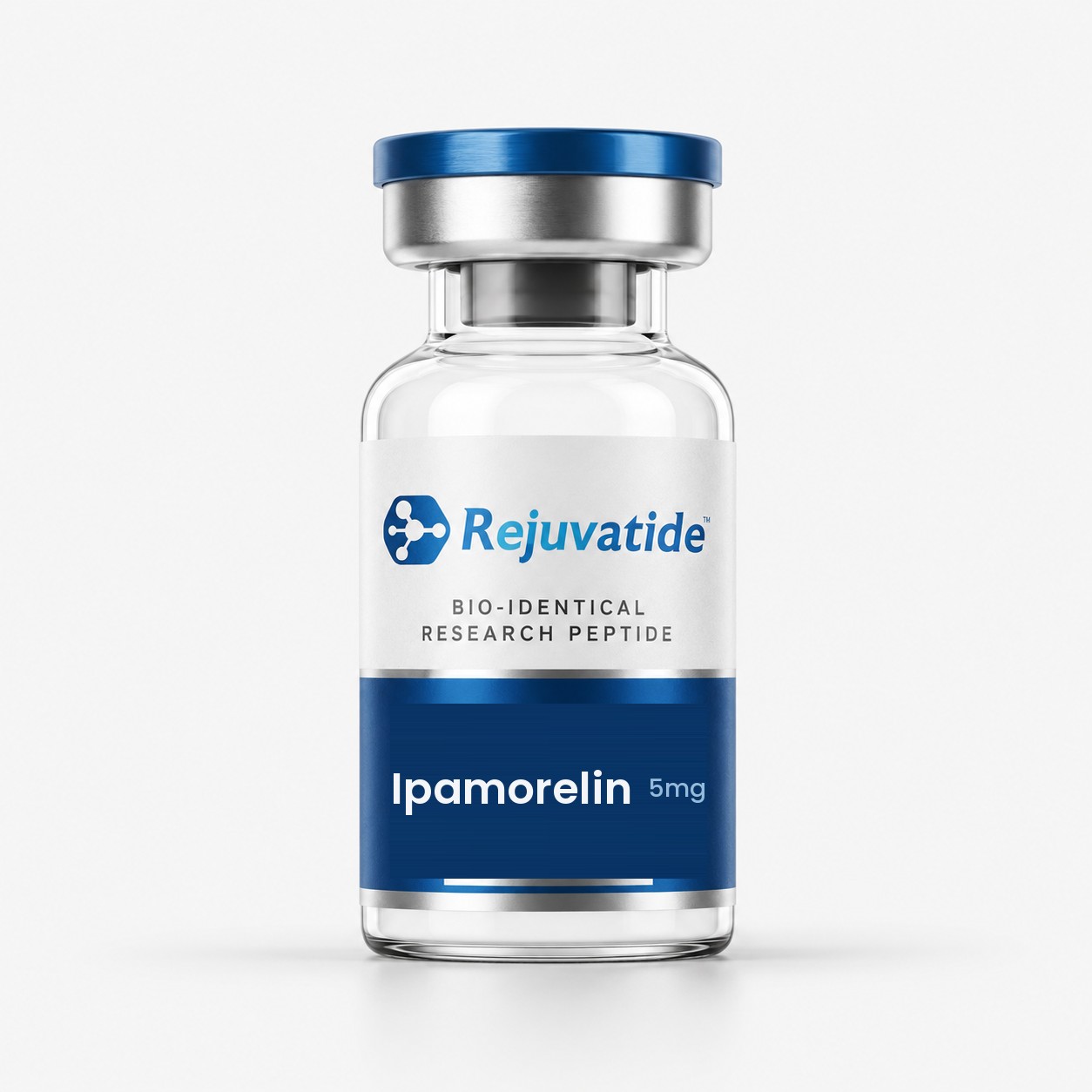
Status checked October 12, 2026. Rejuvatide supplies ipamorelin strictly as a research chemical for in vitro and laboratory use. It is not sold for human or veterinary use.
Testing and quality
Every Rejuvatide lot of ipamorelin is tested by an independent laboratory for purity by HPLC and identity by mass spectrometry, and is also tested for endotoxin. The current certificates are shown below and in our COA library, where you can match the lot number on your vial to its report. Certificates are published exactly as the laboratory issued them.
Ipamorelin is also a component of the CJC-1295 No DAC + Ipamorelin blend. For comparison work with the older, less selective secretagogues, see GHRP-2 and GHRP-6, or browse all growth-axis research peptides.
Storage of lyophilized material
Ipamorelin ships as a lyophilized (freeze-dried) powder, which is stable at ambient temperature during transit. For long-term storage, keep sealed vials at -20°C, protected from light and moisture. Allow a vial to reach room temperature before opening to limit condensation. Handling of any prepared solutions should follow your laboratory's own validated procedures.