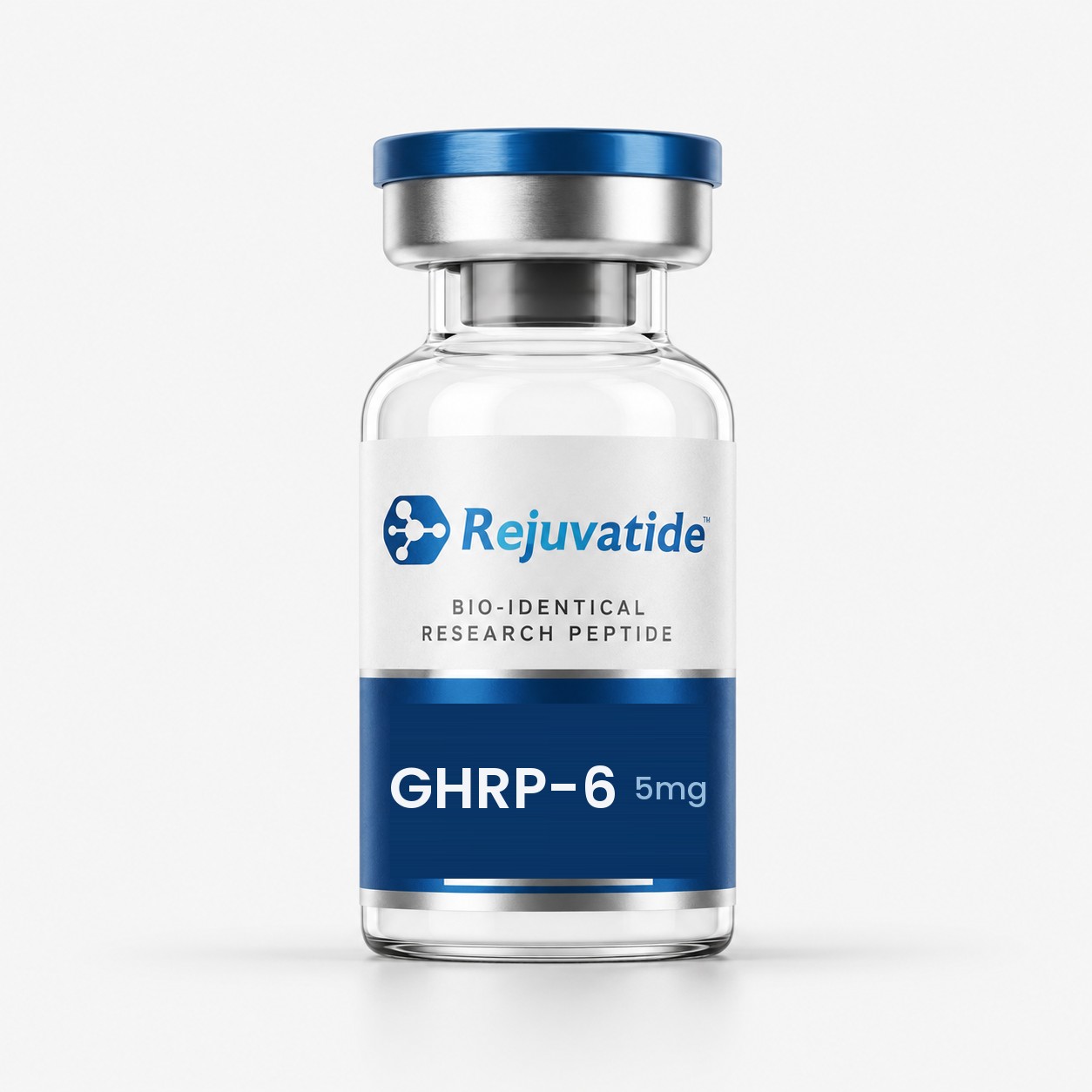
Research overview
GHRP-6: what the research shows
What is GHRP-6?
GHRP-6 is a synthetic hexapeptide amide, His-D-Trp-Ala-Trp-D-Phe-Lys-NH2, and one of the founding compounds of growth hormone secretagogue research [1]. It was described in 1984 by Bowers and colleagues, who reported that it released growth hormone (GH) in vitro and in vivo without a concomitant release of LH, FSH, TSH, or prolactin, and that it was active across several species, including rats, monkeys, lambs, and calves [2].
The authors proposed that GHRP-6 acted at a direct pituitary site and that it might be a valuable tool for investigating somatotroph function [2]. At the time, the receptor it acts on had not been identified. That came in 1996 [3], and the receptor's natural ligand, ghrelin, was identified three years later [4]. GHRP-6 has therefore served for decades as a reference agonist against which newer secretagogues, such as ipamorelin, are compared [5].
| Sequence | His-D-Trp-Ala-Trp-D-Phe-Lys-NH2 |
|---|---|
| Length | 6 residues (hexapeptide amide) |
| Molecular formula | C46H56N12O6 |
| Molecular weight | 873.0 g/mol |
| CAS number | 87616-84-0 |
| PubChem CID | 9919153 |
| Other names | Growth hormone releasing hexapeptide, GH-releasing peptide-6, SK&F-110679, [His1,Lys6]-GHRP (PubChem synonyms) |
Mechanisms studied
The ghrelin receptor (GHS-R1a)
The G protein-coupled receptor cloned from pituitary and hypothalamus in 1996 was shown to be the target of GH secretagogues and to define a pathway controlling pulsatile GH release [3]. The International Union of Pharmacology named it the ghrelin receptor after ghrelin was identified as its endogenous ligand [6]. In primary rat pituitary cells, GHRP-6 and ipamorelin released GH with similar potency and efficacy, and antagonist profiling placed both at a GHRP-type receptor [5].
Effects beyond GH
Unlike the more selective ipamorelin, GHRP-6 increased plasma ACTH and cortisol in swine [5]. When given directly into the cerebral ventricles of sated rats, GHRP-6 increased the incidence of eating without a corresponding change in plasma GH, and the authors suggested a central mechanism independent of its GH-releasing property [7]. This made GHRP-6 an early probe for central ghrelin-receptor signaling, before ghrelin itself was known.
CD36 as a second binding site
Researchers studying the GHRP family's cardiovascular actions identified the scavenger receptor CD36 in rat cardiac membranes as a binding protein for hexarelin, a related hexapeptide, and showed that its coronary effects were absent in CD36-deficient hearts [8]. This CD36 interaction is one proposed explanation for cardiac effects of GHRPs that do not depend on GH.
Disposition in animal models
In a 1998 rat pharmacokinetic comparison, GHRP-6 was predominantly excreted in bile and had a systemic plasma clearance about five times higher than that of ipamorelin [9].
Areas of research
Myocardial injury models
The largest body of recent GHRP-6 work concerns cytoprotection in the heart. In a 2007 study in pigs with one hour of coronary artery occlusion followed by reperfusion, the GHRP-6 group showed smaller infarct mass and thickness than the saline group, and oxidative stress markers suggested reduced reactive oxygen species and preserved antioxidant defenses [10]. A 2024 rat study reported that GHRP-6 given alongside doxorubicin prevented the development of dilated cardiomyopathy in that model, with preserved left ventricular systolic function, increased expression of the pro-survival gene Bcl-2, and preserved cardiomyocyte mitochondrial integrity [11]. A 2026 rat study using permanent coronary ligation reported reduced interstitial fibrosis and improved left ventricular physiology, with proteomic changes in fatty acid oxidation, anti-apoptotic, and antioxidant pathways [12].
A caveat applies: most of this cardioprotection literature comes from one collaborating research group, and independent replication in other laboratories is limited.
Bone models
In a 12-week study in young adult female rats, GHRP-6, ipamorelin, and GH each increased bone mineral content measured by DXA. Further analysis showed that this reflected larger bone dimensions, while volumetric bone mineral density was unchanged [13].
Gastrointestinal motility models
In a rat model of postoperative ileus, a single administration of GHRP-6 shortened the time to the first bowel movement compared with vehicle, an effect it shared with ipamorelin [14].
Open research questions
- How much of the cardiac effect in each model depends on the ghrelin receptor, CD36, or downstream GH and IGF-1 signaling.
- Whether the cytoprotection findings replicate in independent laboratories and in other species.
- How central feeding-related signaling and adrenal-axis activation should be controlled for when GHRP-6 is used as a GH-axis tool compound.
State of the human evidence
Published human data on GHRP-6 are limited to pharmacology. A 2013 study measured its pharmacokinetics in nine healthy male volunteers after a single administration and described a bi-exponential disposition with a short elimination phase measured in hours [15]. No efficacy trial has led to an approved product.
Doping-control laboratories have reported detecting GHRP-6 and GHRP-2 in urine samples from athletes [16]. A 2026 narrative review of GH-axis peptides used outside medical supervision described reported adverse effects across the class, including cortisol and prolactin elevations and dysglycaemia, and stressed the uncertainty about product composition in unregulated supply chains [17]. FDA likewise notes limited safety information for GHRP-6, with concerns including effects on cortisol and on blood glucose [18].
Regulatory status
- Not FDA approved. A search of Drugs@FDA on October 12, 2026 returned no approved drug product containing GHRP-6 [19].
- Compounding. FDA's list of bulk drug substances that may present significant safety risks (content current as of April 22, 2026) places GHRP-6 in category 2 under the 503B interim policy, added September 29, 2023, citing a potential risk of immunogenicity and safety concerns including a potential effect on cortisol and increased blood glucose through decreased insulin sensitivity [18].
- Sport. The World Anti-Doping Agency 2026 Prohibited List names GHRP-6 under S2.2.4, among GH-releasing peptides, within class S2, which is prohibited at all times [20].
Status checked October 12, 2026. Rejuvatide supplies GHRP-6 strictly as a research chemical for in vitro and laboratory use. It is not sold for human or veterinary use.
Testing and quality
Every Rejuvatide lot of GHRP-6 is tested by an independent laboratory for purity by HPLC and identity by mass spectrometry, and is also tested for endotoxin. The current certificates are shown below and in our COA library, where you can match the lot number on your vial to its report. Certificates are published exactly as the laboratory issued them.
For comparison studies, see the related secretagogues GHRP-2 and ipamorelin, or browse all growth-axis research peptides.
Storage of lyophilized material
GHRP-6 ships as a lyophilized (freeze-dried) powder, which is stable at ambient temperature during transit. For long-term storage, keep sealed vials at -20°C, protected from light and moisture. Allow a vial to reach room temperature before opening to limit condensation. Handling of any prepared solutions should follow your laboratory's own validated procedures.