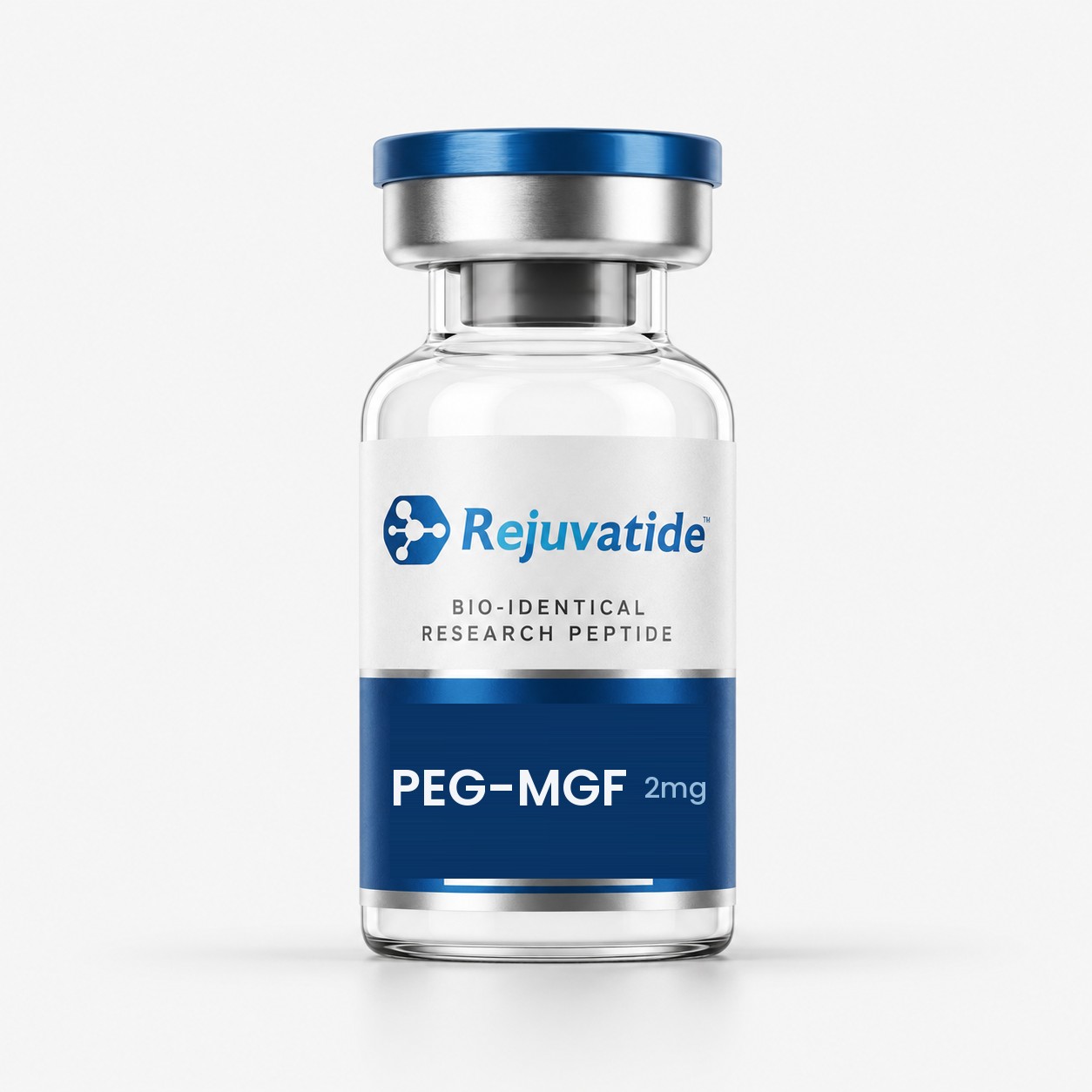
Research overview
PEG-MGF: what the research shows
What is PEG-MGF?
PEG-MGF is mechano growth factor (MGF) with polyethylene glycol (PEG) chains attached. MGF itself is a synthetic peptide matching the C-terminal E domain of an IGF-1 splice variant, IGF-1Ec in humans and IGF-1Eb in rodents [1]. The background, mechanisms, and open questions for the parent peptide are covered on our MGF research page.
We want to be direct about the evidence. As of October 12, 2026, a PubMed search for PEG-MGF returned a single record: a 2026 narrative review that lists PEGylated MGF among IGF-1 analogues marketed as "research compounds," notes the absence of regulatory approval and the uncertainty around product composition in unregulated supply chains, and stratifies such peptides into evidence tiers that run down to a complete absence of human studies [2]. We did not find a peer-reviewed study that tested PEG-MGF itself in cells or animals. Most of what is said about PEG-MGF online is an extrapolation from MGF plus general PEGylation chemistry.
| Name | PEGylated mechano growth factor (PEG-MGF) |
|---|---|
| Base peptide | Mechano growth factor (MGF), the E-domain peptide of an IGF-1 splice variant |
| Modification | Conjugation to polyethylene glycol (PEG) |
| PubChem | No PubChem compound record (checked 2026-10-12) |
| Peer-reviewed studies | None found that test PEG-MGF itself (PubMed, checked 2026-10-12) |
What PEGylation changes
PEGylation is a long-established technique in peptide and protein chemistry. A 2003 review in Nature Reviews Drug Discovery explained that attaching PEG chains increases a molecule's mass and shields it from proteolytic enzymes, which can slow renal clearance and degradation and so lengthen circulating half-life for many peptides and proteins [3]. Whether, and by how much, this applies to the MGF peptide has not been reported in the peer-reviewed literature.
PEG is not biologically invisible. A 2015 review described antibodies that bind PEG itself, which can accelerate clearance of PEGylated molecules. In animals this response was typically robust but short-lived, and the review noted that anti-PEG antibodies have been detected even in healthy untreated people, with many questions about human anti-PEG immunity still open [4]. This is one reason PEGylated research compounds should not be assumed to behave like their parent peptide.
What the evidence covers
- Parent peptide. Cell and animal studies of the unmodified MGF peptide exist, but a 2014 replication attempt by two pharmaceutical research groups found no effect on myoblast or muscle stem cell proliferation or differentiation [5]. See the MGF page for detail.
- PEG-MGF itself. No peer-reviewed cell, animal, or human study was found [2].
- Human data. FDA's compounding safety-risk page states that the agency identified no human exposure data for PEG-MGF by any route [6].
Any laboratory work with PEG-MGF is, in practice, characterization work: confirming identity and conjugation, and comparing it against unmodified MGF and mature IGF-1 as controls.
Regulatory status
- Not FDA approved. No drug application for PEG-MGF appears in FDA's Drugs@FDA database, as checked on October 12, 2026 [7].
- Compounding. FDA's list of bulk drug substances that may present significant safety risks (content current as of April 22, 2026) lists Mechano Growth Factor Pegylated (PEG-MGF) among substances whose nominations were withdrawn. FDA noted that compounded drugs containing it may pose a significant risk of immunogenicity, cited complexities in peptide-related impurities and characterization, and stated that it had identified no human exposure data [6]. PEG-MGF was not among the six peptides that FDA's Pharmacy Compounding Advisory Committee recommended for the 503A bulks list in July 2026 [8].
- Sport. The World Anti-Doping Agency's Prohibited List names mechano growth factors (MGFs) under S2.3, growth factors and growth factor modulators, prohibited at all times [9].
Rejuvatide supplies PEG-MGF strictly as a research chemical for in vitro and laboratory use. It is not sold for human or veterinary use.
Testing and quality
A lot-specific certificate of analysis for PEG-MGF is not yet published on this site. You can request the batch COA through our COA library, and we will only describe tests for this product once the laboratory's certificate is posted there. Ordering and shipping questions are answered in our FAQ.
Browse related compounds in growth-axis research, including MGF and IGF-1 LR3.
Storage of lyophilized material
PEG-MGF ships as a lyophilized (freeze-dried) powder. For long-term storage, keep sealed vials at -20°C, protected from light and moisture. Allow a vial to reach room temperature before opening to limit condensation. Handling of any prepared solutions should follow your laboratory's own validated procedures.