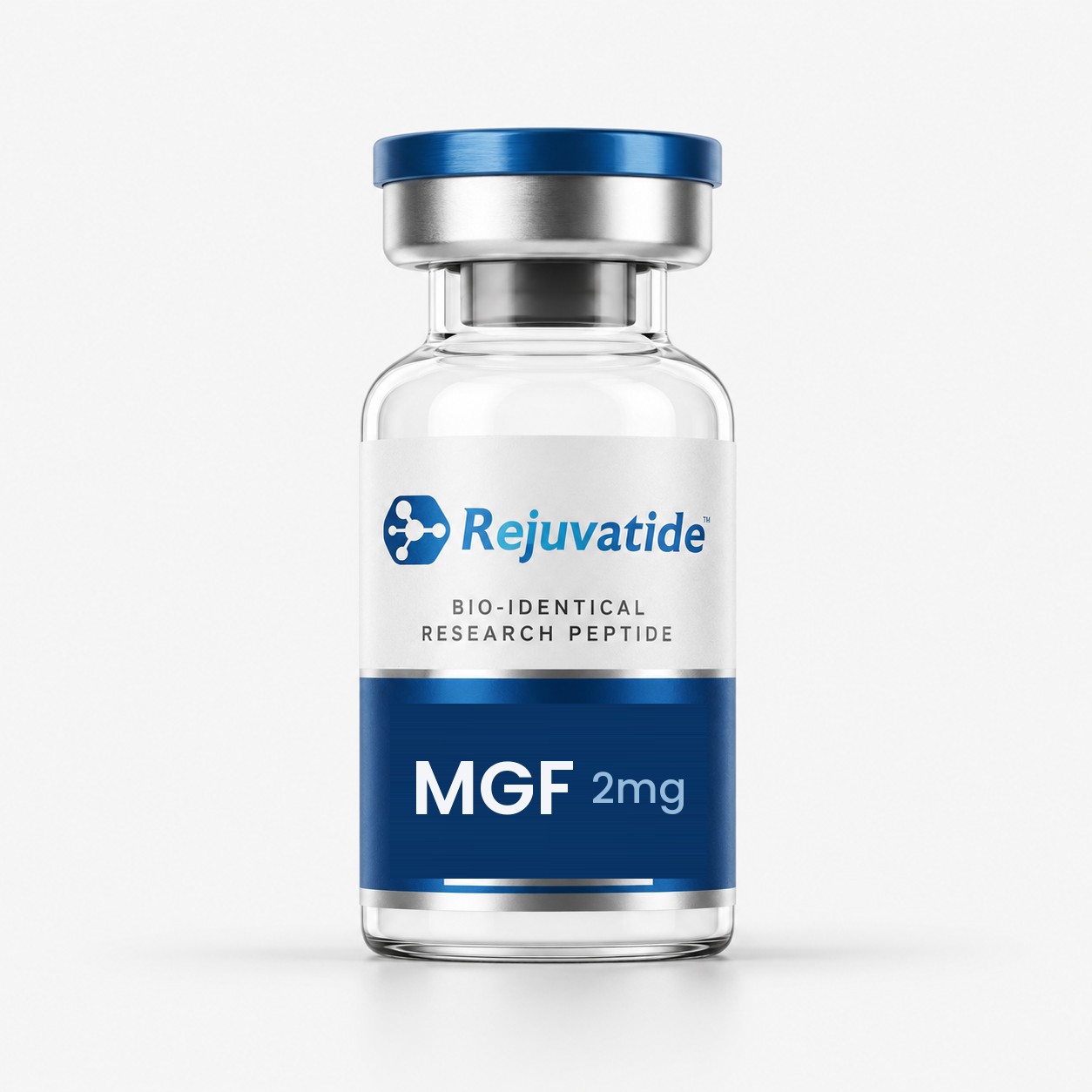
Research overview
MGF: what the research shows
What is MGF?
The IGF1 gene is alternatively spliced into several messenger RNA variants. One of them, which carries a short insert that shifts the reading frame of the C-terminal E domain, was named mechano growth factor because its expression in skeletal muscle rose in response to mechanical loading and local damage. In humans this variant is called IGF-1Ec; the rodent equivalent is IGF-1Eb [1] [2].
The research compound sold as "MGF" is not the full splice-variant protein. It is a synthetic peptide matching the C-terminal end of the variant E domain, usually described as its 24 most C-terminal residues. A 2010 review in Endocrinology made an important distinction here: although this synthetic peptide has been reported to promote proliferation and survival of cultured cells, no matching peptide product of the IGF1 gene had been identified in or isolated from cells, conditioned medium, animal tissue, or biological fluid at the time of that review [2]. In other words, "MGF" in the literature can mean an mRNA splice variant, a full-length pro-protein, or a short synthetic peptide, and findings for one do not automatically apply to the others.
The literature on the synthetic peptide is modest in size, and a substantial share of the early work came from Goldspink and collaborators at University College London. Readers should weigh it alongside the independent replication attempt summarized below.
| Name | Mechano growth factor (MGF), the E-domain peptide of an IGF-1 splice variant |
|---|---|
| Parent gene | IGF1 (insulin-like growth factor 1) |
| Splice variant | IGF-1Ec in humans, called IGF-1Eb in rodents |
| Length | Usually described as the 24 C-terminal residues of the variant E domain |
| PubChem | No PubChem compound record (checked 2026-10-12) |
| Related product | PEG-MGF, a PEGylated form (see link in the text) |
Mechanisms studied
Myoblast proliferation versus differentiation
In a 2002 cell-culture study, Yang and Goldspink reported that the distinct MGF E-domain peptide increased myoblast proliferation while inhibiting terminal differentiation, in contrast to mature IGF-1. When the IGF-1 receptor was blocked with a specific antibody, the E-domain effect persisted, which led the authors to propose that it acts through a different receptor [3]. That receptor has not been identified.
Expression timing after muscle damage
In a rat tibialis anterior model of local damage, Hill and colleagues tracked expression of the two IGF-1 splice forms. MGF expression rose before the satellite-cell marker M-cadherin, while the liver-type IGF-1Ea variant peaked later. The authors interpreted this as an early MGF pulse that activates satellite cells, followed by IGF-1Ea that supports the later stages of repair [4]. This was an expression study of the endogenous variant, not a test of the synthetic peptide.
MAPK-ERK1/2 signaling
In MC3T3-E1 osteoblast-like cells, a 24-residue C-terminal MGF E peptide showed higher pro-proliferative activity than IGF-1 in the same assay, and the authors linked the effect mainly to activation of the MAPK-ERK1/2 pathway [5].
Areas of research
Muscle progenitor cells
Kandalla and colleagues applied the 24-residue MGF E peptide to primary human muscle cell cultures from donors of different ages. They reported an extended proliferative life span and delayed senescence of satellite cells from neonatal and young adult muscle, but not from older adult muscle, along with larger myotubes in all cultures [1].
Bone and tendon models
In a rabbit radius segmental-defect model, the same 2011 study that described ERK1/2 signaling in osteoblasts reported improved radiographic and histological defect-healing scores in the higher-exposure group compared with untreated controls [5]. In a rat Achilles tendon injury model, a synthetic MGF E peptide variant (MGF-C25E) was associated with a higher Achilles functional index, greater repaired-tendon stiffness, and histological signs of tissue remodeling and cell alignment compared with saline controls [6].
Cardiac ischemia models
In a sheep model of experimentally induced myocardial infarction, animals given the MGF E-domain peptide showed better-preserved cardiac function on echocardiography and less compromised myocardium than controls eight days later, and cleaved caspase-3 staining was absent in E-domain-treated hearts [7].
Neural models
In a gerbil model of transient brain ischemia, a synthetic MGF C-terminal peptide was reported to protect vulnerable hippocampal neurons, and in organotypic hippocampal cultures it was reported to act independently of the IGF-1 receptor [8]. Separately, a 2017 study used transgenic mice that overexpressed MGF and reported more proliferating cells in the hippocampal dentate gyrus and subventricular zone. That study tested genetic overexpression, not the synthetic peptide [9].
The replication question
In 2014, scientists at two pharmaceutical research organizations published a direct attempt to reproduce the core in vitro claims for the MGF peptide. The peptide did not increase proliferation of C2C12 cells or primary human skeletal myoblasts, and it did not inhibit their differentiation into myotubes. Primary mouse muscle stem cells also showed no significant response, and neither the native nor a stabilized MGF peptide activated p-ERK in cardiac myocytes. In the same experiments, mature IGF-1 and full-length IGF-1Eb produced clear responses. The authors concluded that their results call into question whether MGF has a physiological role [10].
Together with the 2010 review noting that no endogenous MGF peptide had been isolated from tissue [2], this leaves MGF as a contested research tool. Laboratories using it may want positive controls such as mature IGF-1, and independent confirmation of any effect they observe.
State of the human evidence
Human data for the synthetic MGF peptide are limited to cultured human cells such as the myoblast work above [1] [10]. We found no controlled clinical studies of the synthetic peptide in PubMed as of the review date. A 2026 narrative review of growth-hormone and IGF-1 axis peptides marketed as research compounds placed IGF-1 analogues such as PEGylated MGF in a context of absent regulatory approval and uncertain product composition, and highlighted biologically plausible but unproven mitogenic concerns [11].
Findings in cell, rodent, rabbit, and sheep models should not be read as evidence of safety or benefit in people.
Regulatory status
- Not FDA approved. No drug application for MGF appears in FDA's Drugs@FDA database, as checked on October 12, 2026 [12].
- Sport. The World Anti-Doping Agency's Prohibited List names mechano growth factors (MGFs) under S2.3, growth factors and growth factor modulators, prohibited at all times [13].
Rejuvatide supplies MGF strictly as a research chemical for in vitro and laboratory use. It is not sold for human or veterinary use.
Testing and quality
Each Rejuvatide lot of MGF is tested by an independent laboratory for purity by HPLC with identity confirmed by mass spectrometry, and the lot also carries an endotoxin certificate. The current certificates are shown below and in our COA library, where you can match the lot number on your vial to its report. Certificates are published exactly as the laboratory issued them.
A PEGylated form is listed separately as PEG-MGF. For the parent molecule's research context, see IGF-1 LR3, or browse all growth-axis research compounds. General ordering and handling questions are answered in our FAQ.
Storage of lyophilized material
MGF ships as a lyophilized (freeze-dried) powder. For long-term storage, keep sealed vials at -20°C, protected from light and moisture. Allow a vial to reach room temperature before opening to limit condensation. Handling of any prepared solutions should follow your laboratory's own validated procedures.