Research overview
AOD-9604: what the research shows
What is AOD-9604?
AOD-9604 is a synthetic 16-amino-acid peptide modeled on the carboxyl (C-terminal) end of human growth hormone. Analytical chemists at a US anti-doping laboratory described it as the growth hormone fragment spanning amino acids 177 to 191, with one extra tyrosine residue added to the N-terminus [1]. In the PubChem structure record, the two cysteines in the sequence are joined by a disulfide bond, giving the peptide a small ring between positions 7 and 14 [2]. Some reviews and suppliers refer to it as "hGH 176-191" or "Modified GH Fragment 176-191" [12].
The compound grew out of a research program at Monash University in Australia that set out to locate the part of growth hormone responsible for its effects on fat metabolism. In 1993 that group reported that a synthetic hGH 177-191 peptide reproduced the antilipogenic activity of the intact hormone in rat adipose tissue [3]. Later papers described an earlier synthetic version of the domain, called AOD9401, and then the tyrosine-extended AOD9604 [4] [5].
AOD-9604 is a fragment of growth hormone itself. It is different from growth-hormone-releasing hormone (GHRH) analogs such as CJC-1295 No DAC, which are studied for their action on the pituitary gland rather than on fat cells. Browse other compounds in our metabolic research category.
| Sequence | Tyr-Leu-Arg-Ile-Val-Gln-Cys-Arg-Ser-Val-Glu-Gly-Ser-Cys-Gly-Phe (YLRIVQCRSVEGSCGF), with a disulfide bond between the two cysteines |
|---|---|
| Length | 16 amino acids (human growth hormone residues 177-191 plus an N-terminal tyrosine) |
| Molecular formula | C78H123N23O23S2 |
| Molecular weight | 1815.1 g/mol |
| CAS number | 221231-10-3 |
| PubChem CID | 71300630 |
| Other names | AOD9604, AOD 9604 (PubChem synonyms) |
Mechanisms studied
Most of what is known about how AOD-9604 acts comes from a small number of rodent and tissue studies, largely from a single research group. The proposed mechanisms below have not been confirmed in humans.
Lipolytic and lipogenic enzymes in adipose tissue
In isolated rat adipose tissue, the AOD9401 fragment (hGH 177-191) stimulated hormone-sensitive lipase and inhibited acetyl coenzyme A carboxylase, matching the direction of the effects produced by intact human growth hormone. It also reproduced the effect of intact growth hormone on diacylglycerol release from adipocytes [4]. The earlier 1993 work had found antilipogenic activity for hGH 177-191 but no significant lipolytic effect, measured as glycerol release from rat fat pads [3], so the balance between the two actions differed between studies and preparations.
No binding to the growth hormone receptor
A 2001 study tested whether AOD9604 works through the classical growth hormone receptor. In BaF-BO3 cells transfected with the human growth hormone receptor, AOD9604 did not compete with labeled growth hormone for receptor binding and did not induce cell proliferation, whereas intact growth hormone did both [6]. The authors concluded that the fragment acts through a pathway separate from the receptor that mediates growth hormone's growth-promoting effects.
The beta-3 adrenergic receptor
A companion study in obese mice found that both growth hormone and AOD9604 raised expression of beta-3 adrenergic receptor RNA in adipose tissue, restoring it toward the levels seen in lean animals. In beta-3 receptor knockout mice, longer-term exposure to either compound did not produce the changes in body weight and lipolysis seen in wild-type controls. In a short-term experiment, however, AOD9604 still increased energy expenditure and fat oxidation in the knockout animals. The authors concluded that the lipolytic actions are not mediated directly through the beta-3 receptor, although increased receptor expression may contribute to greater lipolytic sensitivity [5].
Areas of research
Adipose metabolism in obese rodent models
The core AOD-9604 literature comes from genetically obese rodents. In obese Zucker rats, AOD9604 reduced body-weight gain compared with controls and increased lipolytic activity in adipose tissue. Using euglycemic clamp measurements, the authors reported no adverse effect on insulin sensitivity, in contrast to chronic exposure to intact growth hormone [7]. In a separate Zucker rat study of AOD9401, average adipocyte diameter decreased from about 110 to about 80 micrometres, and the fragment did not induce insulin resistance or glucose intolerance [4].
In obese (ob/ob) and lean C57BL/6J mice, a 14-day study compared AOD9604 with intact growth hormone. Both reduced body-weight gain in obese mice, and both were associated with higher fat oxidation and higher plasma glycerol, an index of lipolysis. Unlike growth hormone, AOD9604 did not produce hyperglycaemia or reduce insulin secretion [6]. A further mouse study with AOD-9401 reported lower lipogenic and higher lipolytic activity in adipose tissue examined ex vivo, with no difference in food consumption between groups [8].
Human adipose tissue in vitro
The same 2000 study also examined isolated adipose tissue from obese humans in the laboratory. AOD-9401 increased lipolytic activity and decreased lipogenic activity in these tissue samples, as it did in tissue from obese rodents [8]. This is a tissue-culture finding, not a clinical one.
Cartilage models
Outside metabolism, one 2015 study examined AOD9604 in a collagenase-induced knee osteoarthritis model in rabbits. The authors reported lower gross morphological and histopathological cartilage-degeneration scores in the AOD9604 groups than in saline controls, with the lowest scores when AOD9604 was combined with hyaluronic acid [9]. This remains a single small animal study.
Analytical chemistry and metabolism
Because AOD-9604 is prohibited in sport, anti-doping laboratories have developed methods to detect it. A 2015 study validated a solid-phase extraction method for urine and identified six potential metabolites after incubating the peptide in serum and urine. One metabolite, consisting of the internal sequence CRSVEGSCG, was significantly more stable than the parent peptide or the other metabolites [1]. The same authors noted that the peptide had been identified in confiscated vials in the United States, a reminder that identity testing of any supply matters.
Open research questions
- Independent replication: most mechanistic and animal work was published by one research group between 1993 and 2001.
- The receptor or signaling partner that mediates the reported adipose effects remains unidentified, since the peptide did not bind the growth hormone receptor in the published assay [6].
- How results with AOD9401 (residues 177-191) translate to the tyrosine-extended AOD9604 in each experimental system.
State of the human evidence
AOD-9604 entered clinical development in the early 2000s, and a 2004 drug-development profile reported that phase IIa trials were under way by February 2002 [10]. Peer-reviewed reports of controlled human trials are not readily found in PubMed, and the compound was never approved as a medicine.
Recent reviews place AOD-9604 among unapproved peptides marketed outside regulatory oversight. A 2026 narrative review in sports medicine concluded that while many such peptides show favorable outcomes in animal models, rigorous human safety data are scarce [11]. Another 2026 review of compounds that act on the growth hormone axis, which lists AOD9604 among them, grouped peptides into evidence tiers ranging from regulatory-grade trial data to a complete absence of human studies [12]. FDA has stated that it identified no, or only limited, safety-related information for AOD-9604 [13].
Findings from rodent, rabbit, and tissue models should not be read as evidence of safety or benefit in people.
Regulatory status
Checked against primary sources on October 12, 2026.
- Not FDA approved. No application for AOD-9604 appears in FDA's Drugs@FDA database of approved drug products [14].
- Compounding. FDA's page on bulk drug substances that may present significant safety risks (content current as of April 22, 2026) lists AOD-9604 among substances previously in category 2 whose nominations were withdrawn. FDA's note states that compounded drugs containing it may pose a significant risk of immunogenicity for certain routes of administration, may have complexities with peptide-related impurities and characterization, and that FDA identified serious adverse events that may be associated with AOD-9604, though causality is not clear [13].
- Sport. The World Anti-Doping Agency's 2026 Prohibited List names AOD-9604 as an example of a growth hormone fragment under section S2.2.3, within substances prohibited at all times [15].
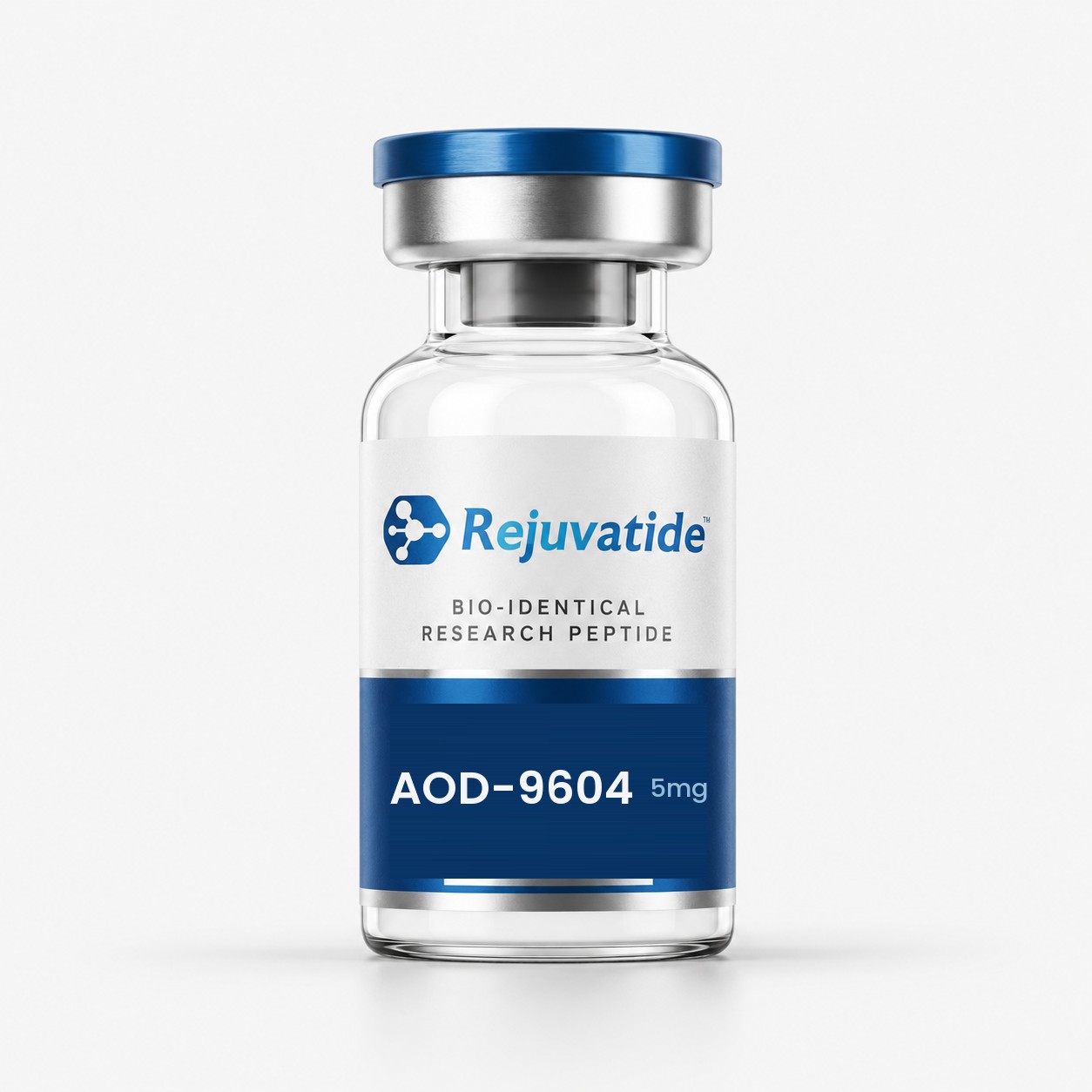
Rejuvatide supplies AOD-9604 strictly as a research chemical for in vitro and laboratory use. It is not sold for human or veterinary use.
Testing and quality
Every Rejuvatide lot of AOD-9604 is tested by an independent laboratory for purity by HPLC and identity by mass spectrometry, and is also tested for endotoxin. The current certificates are shown below and in our COA library, where you can match the lot number on your vial to its report. Certificates are published exactly as the laboratory issued them.
Identity testing matters for this compound in particular: AOD-9604 differs from the AOD9401 fragment by a single tyrosine, and mass spectrometry distinguishes the two. Answers to common ordering and shipping questions are on our FAQ page.
Storage of lyophilized material
AOD-9604 ships as a lyophilized (freeze-dried) powder, which is stable at ambient temperature during transit. For long-term storage, keep sealed vials at -20°C, protected from light and moisture. Allow a vial to reach room temperature before opening to limit condensation. Handling of any prepared solutions should follow your laboratory's own validated procedures.